
Motorcycle Parts, Yamaha Motorcycle
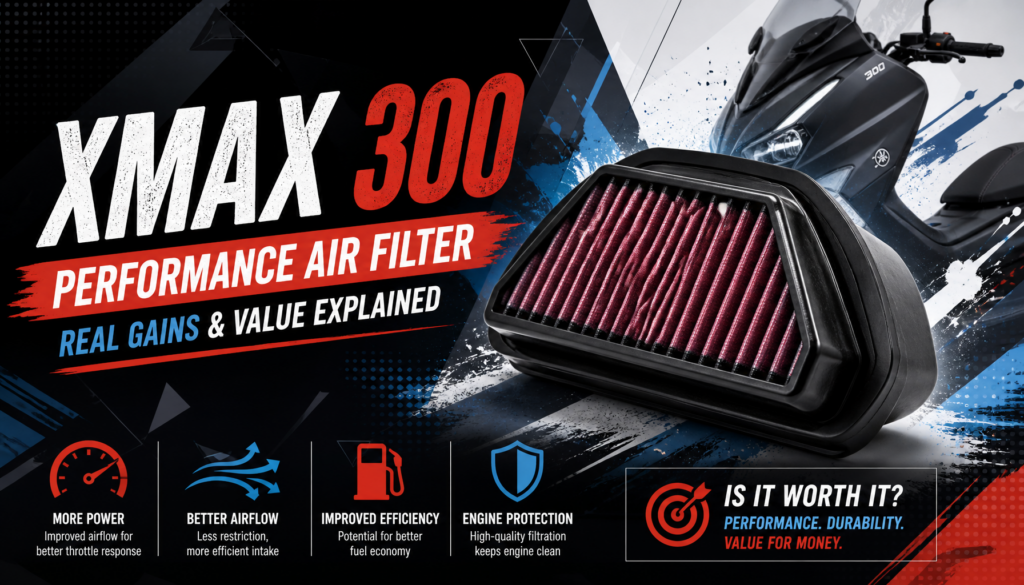
XMAX 300 Performance Air Filter: Real Gains & Value Explained
Jul
XMAX 300 Performance Air Filter: Riders searching for an edge know how frustrating it is to hit a performance plateau. Even small upgrades can feel confusing or risky, especially with so many options on the market. The XMAX 300 Performance Air Filter promises both real gains and lasting value, but is the hype justified?
This article breaks down how this air filter actually affects your scooter’s horsepower, throttle response, and fuel efficiency. You’ll learn what makes it different from a stock filter and whether it’s worth your money in 2024. We’ll explore installation tips, long-term maintenance, and what real owners are saying. If you want honest answers about scooters and smart upgrades, keep reading for a clear look at the XMAX 300 Performance Air Filter.
Unlocking XMAX 300 Performance: Do Air Filters Make a Real Difference?
XMAX 300 Performance Air Filter: When considering an upgrade like the XMAX 300 Performance Air Filter, it’s natural to ask: does this modification really change your riding experience? Many Yamaha XMAX 300 owners have heard promises of more power and improved acceleration, but the facts can get muddied by exaggerated marketing claims. If you’re looking for honest, practical gains rather than hype, it’s crucial to understand what a performance filter can (and cannot) do for your scooter.
An upgraded air filter is designed to allow for higher airflow compared to standard OEM paper filters. In theory, more air means more efficient combustion and the potential for a modest boost in horsepower or torque. Real-world tests sometimes show small but noticeable improvements in throttle response and smoother power delivery, especially in city conditions where stop-and-go acceleration is common. Riders sensitive to their XMAX 300’s engine behavior often appreciate the enhanced responsiveness that a less restrictive filter provides.
XMAX 300 Performance Air Filter: However, it’s important to set realistic expectations. Most performance gains from an aftermarket air filter alone are subtle – typically limited to marginal improvements that may not translate to large horsepower increases without complementary upgrades. The Yamaha XMAX 300’s ECU generally adapts to mild airflow changes, so you won’t usually need ECU tuning just for a filter swap. Still, pairing filter upgrades with exhaust or fuel system mods may warrant an ECU remap to avoid potential risks like running lean.
Beyond performance, the value of the XMAX 300 Performance Air Filter emerges in other areas: washable, reusable designs can provide savings over time if maintained correctly. Some riders choose these filters for their durable cotton or foam construction, reducing frequent replacements and environmental waste. For most everyday commuters, the real benefits are better throttle feel and potentially lower filter maintenance costs, rather than massive power gains.
Ultimately, upgrading your XMAX 300’s air filter should be seen as a smart, incremental improvement—excellent for those who want a more responsive ride with minimal fuss, and especially valuable for city riders seeking every advantage in performance and efficiency.
Quick Specs: XMAX 300 Performance Air Filter vs. OEM
| Feature | XMAX 300 OEM Air Filter | XMAX 300 Performance Air Filter |
|---|---|---|
| Material | Paper (disposable) | Cotton or foam (reusable) |
| Filtration Efficiency | High (fine particulate trapping) | High (with optimized airflow) |
| Reusability | No – must be replaced | Yes – can be cleaned and reused |
| Claimed Performance Gains | Stock – no additional gains | Improved throttle response, slight increase in horsepower/torque (claimed) |
| Estimated Maintenance Interval | Replace every 12,000 km (varies by conditions) | Clean every 8,000–15,000 km (varies by brand and environment) |
XMAX 300 Performance Air Filter: For owners considering an upgrade, this quick specs table highlights where a XMAX 300 Performance Air Filter differentiates itself from the original paper OEM filter. Many riders opt for performance filters, made from cotton or foam, thanks to their reusability and cleaning-friendly design. While both filter types deliver high filtration efficiency, performance options are designed to offer an increase in airflow—potentially improving throttle response and acceleration as claimed by manufacturers.
Routine maintenance requirements also differ. The OEM paper filter must be replaced completely at set intervals, often around every 12,000 km, while the performance version only needs cleaning, reducing waste and long-term expense. It’s important to note that while a performance air filter promises moderate rideability and potential performance gains, actual results may vary based on usage, environmental conditions, and maintenance diligence.
Considering regulations or incentives around waste reduction and long-term value, reusable filters may appeal more to environmentally conscious or high-mileage riders who are looking for cost-effective upgrades. By weighing these quick specs, you can determine whether the XMAX 300 Performance Air Filter is the right investment for your riding habits and performance expectations.
Performance Gains: Fact vs. Fiction
XMAX 300 Performance Air Filter: When evaluating the XMAX 300 Performance Air Filter, it’s important to separate real-world data from marketing hype. Many manufacturers suggest that simply installing a high-flow filter will result in dramatic horsepower or torque gains. However, dyno testing on the Yamaha XMAX 300 shows that while improvements can be measured, they’re often modest. Most tests report minor increases in power output—typically less than one horsepower under ideal conditions. This small boost may not translate to a noticeable difference during everyday riding, especially for those using the scooter for city commutes or moderate speeds.
Where owners and testers consistently notice improvement is in throttle response. The increased airflow permits the engine to “breathe” a bit easier, which can make acceleration feel slightly sharper when twisting the throttle. Feedback from XMAX 300 riders suggests that these gains are most evident during quick bursts of acceleration or when overtaking at mid-range RPMs. For most urban riders, the scooter feels a touch more responsive, which contributes to a more engaging experience.
XMAX 300 Performance Air Filter: It’s crucial to recognize the gap between real-world results and some marketing claims. While manufacturers may hint at transformative gains, the practical outcome is subtle, aligning more with improved rideability and responsiveness than outright speed. The improvement you get from the XMAX 300 Performance Air Filter tends to be most noticeable in specific scenarios, like stop-and-go city traffic, rather than producing dramatic top-end power on the highway.
If you’re seeking genuine performance improvements, pairing the filter with other modifications—such as an ECU remap or fuel controller—may deliver more substantial results. However, for many everyday riders, the value lies in the filter’s enhanced responsiveness and potentially long-term savings from reusability. Understanding these real-world benefits versus marketing claims ensures buyers know what to expect and can make an informed upgrade decision.
Fuel Economy and Everyday Rideability
XMAX 300 Performance Air Filter: Many riders wonder if upgrading to a XMAX 300 Performance Air Filter influences fuel economy and daily rideability. The impact can vary based on riding conditions and the specific filter chosen. A high-flow air filter generally allows the engine to breathe more efficiently, which often leads to subtle improvements in throttle response and smoother acceleration, especially noticeable when moving off from a stop or overtaking in traffic.
For city commuting, a performance air filter can deliver a more responsive feel during frequent start-stop maneuvers. Riders report that engine smoothness is enhanced, with fewer flat spots under rapid acceleration. This improved responsiveness may tempt some to use heavier throttle inputs, potentially offsetting any marginal gains in fuel economy. However, if ridden similarly to stock, most see little to no negative impact on liters per 100 kilometers. It’s important to note that actual mileage changes are usually minor, so the primary benefit is in day-to-day smoothness rather than dramatic savings at the pump.
XMAX 300 Performance Air Filter: On the highway, where the Yamaha XMAX 300 runs at steady RPMs, the performance air filter’s increased airflow is less noticeable but still contributes to stable engine output and less sluggishness during high-speed overtakes. The fuel consumption difference here is typically negligible, as the engine’s ECU is designed to adapt automatically to minor increases in airflow. Real-world dyno testing often shows that any power gains from the filter do not significantly affect overall fuel efficiency.
For most riders using their XMAX 300 for daily errands, commuting, or cross-town rides, upgrading the air filter offers peace of mind with smoother performance and a subtly enhanced ride experience, without sacrificing everyday fuel economy. Investing in a XMAX 300 Performance Air Filter is about refined ride quality and engine responsiveness rather than major MPG improvements — ideal for those who value feel and reliability in diverse urban and highway scenarios.
ECU Compatibility: Do You Need Tuning with an XMAX 300 Performance Air Filter?
XMAX 300 Performance Air Filter: When considering an XMAX 300 Performance Air Filter, one of the top concerns is how your scooter’s ECU (Engine Control Unit) manages the change. Fortunately, the Yamaha XMAX 300’s factory ECU is engineered to compensate for modest increases in airflow that come with upgrading to a performance filter. In most cases, the ECU will make small automatic adjustments to the air-fuel mixture, maintaining safe operating conditions and allowing you to take advantage of improved throttle response and acceleration without extra tuning.
However, if you plan to combine the XMAX 300 Performance Air Filter upgrade with other major modifications—such as a high-flow exhaust or changes to engine internals—these cumulative upgrades can outpace the factory ECU’s adaptive range. When several performance parts work together to increase airflow and exhaust flow, the standard ECU map sometimes cannot enrich fuel delivery enough. This scenario may lead to a risk of running the engine lean: a condition where there’s too much air and not enough fuel, which can raise combustion temperatures and cause long-term engine wear.
To address such risks in heavily modified setups, an ECU remap or adding a standalone fuel controller might be necessary. These allow precise calibration of the fuel mapping, ensuring a safe, optimal mix. City commuters and casual riders who stick to the performance air filter alone, however, will rarely need these extra steps. The factory ECU adaptation is usually more than adequate, maintaining smooth rideability and protecting engine longevity for regular use.
For most Australian riders subject to emissions laws and who prioritize daily reliability, the value of the XMAX 300 Performance Air Filter lies in its real-world gains without demanding extra tuning investments. But if your modifications go beyond the filter, proactively considering tuning solutions can both safeguard your engine and unlock the full performance potential.
Maintenance and Engine Longevity Considerations
XMAX 300 Performance Air Filter: When choosing a XMAX 300 Performance Air Filter, maintenance is an essential factor to consider, particularly if you’re comparing reusable cotton or foam filters with traditional disposable paper filters. Reusable filters, such as those made from cotton or foam, need regular cleaning to maintain their high-flow properties. Most require cleaning every 6,000–10,000 kilometers, depending on riding conditions. This process usually involves removal, washing with a special cleaner, drying, and re-oiling—slightly more effort than simply swapping in a new disposable paper filter every service interval.
Paper air filters, by contrast, are designed for single use. They generally offer good filtration efficiency with minimal fuss: just replace during routine maintenance. While this approach is convenient, it can add to the long-term ownership cost, especially for frequent riders.
XMAX 300 Performance Air Filter: Engine longevity is a key concern for any upgrade. High-flow cotton or foam filters can provide improved throttle response for the Yamaha XMAX 300, but it’s crucial that the filter is properly maintained. Dirty or poorly oiled reusable filters can let larger particles pass, posing a risk of increased engine wear over time. Disposable paper filters, with their dense media, often provide finer filtration out of the box, which benefits engine health—especially if maintenance intervals get stretched.
For city commuters or those riding in dusty conditions, consistent filter cleanliness—and proper oiling for cotton or foam types—is vital for protecting engine internals. Always balance the appeal of performance gains with the reality of your riding environment and ability to keep up with maintenance. A well-maintained XMAX 300 Performance Air Filter can offer real-world benefits, but neglect can reverse those gains and accelerate engine wear. Consider your habits and local air quality when deciding which type of air filter fits your needs and your bike’s longevity.
Cost vs. Value: Is the Upgrade Worth It?
XMAX 300 Performance Air Filter: When considering the XMAX 300 Performance Air Filter, the decision often comes down to balancing the upfront cost against its potential long-term value. While the initial purchase price of a performance filter can be higher compared to a standard OEM paper filter, it’s crucial to factor in the reusable nature of many high-flow cotton and foam options. Unlike disposable filters, these reusable variants only require periodic cleaning and can last for tens of thousands of kilometers, offering substantial savings for frequent riders.
For daily commuters, the value equation centers on practicality and cost-effectiveness. Owners report that although the performance gains—like improved throttle response and a slightly smoother ride—are immediately noticeable, the most tangible benefit is the reduction in ongoing maintenance expenses. Over several years of commuting, not having to buy multiple replacement filters can make the investment worthwhile, especially in areas where parts availability or import costs may inflate prices.
XMAX 300 Performance Air Filter: Performance enthusiasts, on the other hand, are typically drawn to the enhanced acceleration and engine responsiveness that a XMAX 300 Performance Air Filter provides. Feedback from real owners suggests that while outright power gains may be modest, the improvement in rideability makes the scooter feel livelier and more enjoyable, particularly during spirited or highway riding. Enthusiasts also value the flexibility to combine the filter upgrade with further modifications, knowing that the filter itself represents a solid foundation for building additional performance.
Ultimately, real-world satisfaction hinges on expectations. Those who prioritize savings and longevity will appreciate the reusable filter’s reduced maintenance costs, while those seeking peak performance will find its immediate effects rewarding. Whichever camp you fall into, this upgrade stands out as a practical enhancement that both daily riders and enthusiasts can justify, especially in the context of increasing part and service costs in 2024.
XMAX 300 Performance Air Filter vs. Competitors: How Does It Stack Up?
XMAX 300 Performance Air Filter: When considering a XMAX 300 Performance Air Filter upgrade, it’s natural to compare its features and value against both OEM filters and previous-generation alternatives. The performance claims center on improved airflow, which directly contributes to better throttle response and smoother acceleration. While OEM paper filters generally excel in initial filtration efficiency, they require frequent replacement and often restrict airflow more than performance variants. High-flow options, like cotton or foam performance filters, not only boost engine responsiveness but also support sustained power delivery—a real benefit for riders who navigate mixed city and highway conditions.
| Feature | XMAX 300 Performance Air Filter | OEM/Standard Filter |
|---|---|---|
| Airflow | Higher (claims improved throttle response) | Standard (more restrictive) |
| Durability | Reusable; longer lifespan | Disposable; regular replacement needed |
| Maintenance | Periodic cleaning; less waste | Simple replacement |
| Cost Over Time | Higher initial, lower long-term | Lower initial, higher recurring cost |
| Engine Protection | Excellent if maintained properly | Excellent |
Riders upgrading to the XMAX 300 Performance Air Filter often report a sharper and more responsive ride, especially in urban stop-and-go traffic. For those worried about compatibility, the Yamaha XMAX 300’s ECU generally adapts well to increased airflow, maintaining reliable fuel delivery for most daily use. Maintenance shifts from disposable replacements to regular cleaning, which can suit eco-conscious or high-mileage users seeking long-term savings. Ultimately, while the upfront cost of a performance filter may be higher, the blend of improved performance, reusable design, and smoother ride often justifies the investment—especially for enthusiasts or commuters aiming to get the most from their XMAX 300.
Frequently Asked Questions
Will installing a performance air filter on my XMAX 300 void my warranty?
Generally, installing a XMAX 300 Performance Air Filter does not automatically void your manufacturer warranty. However, if an engine issue is directly attributed to the aftermarket filter, the warranty may not cover related repairs. Always check your owner’s manual and consult your Yamaha dealer for specific local policies before making modifications.
How often do I need to clean a performance air filter?
Reusable cotton or foam performance filters should be cleaned at intervals based on riding conditions. For typical urban or highway use with the XMAX 300, inspecting and cleaning every 5,000–10,000 km is common. In dusty or harsh environments, check more frequently to maintain optimal filtration efficiency and engine protection.
Does the XMAX 300 Performance Air Filter work well if I have other modifications?
Yes, the filter is compatible with common mods such as exhaust upgrades. The XMAX 300’s ECU can usually adapt to moderate increases in airflow. If you install multiple high-flow parts or pursue significant performance gains, an ECU remap or fuel controller is sometimes recommended for optimal results and to avoid running lean.
Will a performance filter help my XMAX 300 pass local emissions or safety inspections?
Most high-quality performance air filters are engineered to maintain adequate filtration and should not prevent passing local emissions or inspection laws if the rest of your engine remains stock. Still, local regulations can vary, so verify current standards and ensure your modifications are compliant in your area.
Is installing the performance air filter beginner-friendly?
Yes, installing a XMAX 300 Performance Air Filter is typically straightforward and beginner-friendly. The process often involves removing the stock filter and replacing it with the new one, using only basic tools and following the included instructions. Most riders can complete the installation at home without specialized mechanical skills.
Should You Buy the XMAX 300 Performance Air Filter? Our Verdict
XMAX 300 Performance Air Filter: Deciding whether the XMAX 300 Performance Air Filter is the right upgrade largely depends on your priorities as a rider. For daily commuters seeking improved throttle response and acceleration, this high-flow filter can make your city rides feel noticeably more responsive without major sacrifices in fuel economy. If you value smooth engine performance during stop-and-go traffic or routine highway travel, the modest gains in rideability and engine responsiveness are tangible benefits worth considering.
Touring riders who often log high mileage may also appreciate the reusable nature of cotton or foam filters, which, when cleaned regularly, offer long-term cost savings over disposable paper filters. While the purchase price of the XMAX 300 Performance Air Filter is higher than OEM options, the potential for repeated use can offset the upfront cost. However, diligent maintenance is essential to maximize lifespan and preserve filtration efficiency, reducing the risk of increased engine wear.
XMAX 300 Performance Air Filter: For enthusiasts focused on maximum performance gains, the real-world improvements in horsepower and torque are typically modest, though throttle response feels sharper. Dyno results reveal incremental changes rather than drastic power increases, so those expecting a dramatic transformation should calibrate expectations accordingly. Riders considering additional modifications—such as exhaust upgrades—should note that while the Yamaha XMAX 300 ECU can often compensate for increased airflow, situations may arise where a fuel controller or ECU remap delivers optimal results and helps prevent the engine from running lean.
Our verdict: If your priority is a more responsive ride and the convenience of a reusable filter, the XMAX 300 Performance Air Filter offers solid value, especially when factoring in long-term savings. Everyday commuters and touring enthusiasts will find this upgrade most worthwhile. Before buying, consider your budget, willingness to handle periodic maintenance, and whether incremental performance gains align with your riding needs. This thoughtful approach ensures the investment delivers real rewards—on the road and over the long run.
We at Speedzone specialize in offering top-quality servicing for a variety of premium motorcycle brands. Whether you ride a Yamaha, Honda, KTM, Suzuki, Kawasaki, SYM, Aprilia, Piaggio, or Mutt Motorcycle, you can trust us to keep your ride running smoothly.
Book Your Service Today
Ready to give your motorcycle the care it deserves? Or just curious to know more? With our premium motorcycle accessories available catering to every motorbike models. Book your motorcycle servicing with us or drop by our showroom today and experience the difference of expert servicing tailored to your brand and friendly staffs!
