
Electric vs Petrol motorcycle, Electric bikes, Electric Motorcycles, Electric Scooters vs Motorcycle Scooters, Petrol motorcycle
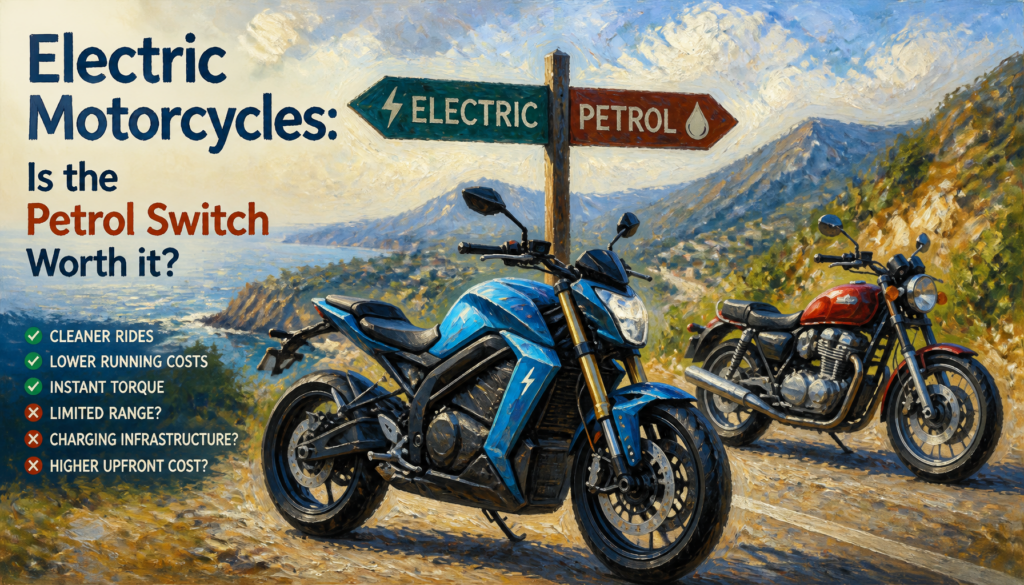
Electric Motorcycles: Is the Petrol Switch Worth it?
Sep
Electric Motorcycles: Many riders feel torn between promise and practicality. Electric Motorcycles can feel smart for the environment, yet every trip still starts with the same question: is the petrol switch worth it? Gas stations are familiar, but charging habits, cost, and range anxiety can still hold people back. In 2026, this is no longer a niche question. More riders are choosing between electric and petrol systems based on daily needs, not hype.
This guide will compare what matters most. We will break down ride comfort, range limits, charging time, maintenance, ownership cost, and long-term reliability. You will also learn which riders benefit most, from short-city commuters to frequent weekend users, and where petrol still has an edge. We keep the review practical with real-world factors and common mistakes to avoid, not product claims. By understanding those tradeoffs first, you can decide if the switch to electric is the right move for your routine and budget.
Electric Motorcycles in 2026: Is the Petrol Switch Worth It for Your Daily Ride
Electric Motorcycles: If you are reading this in 2026, the question is no longer whether Electric Motorcycles are “the future,” but whether they are the right fit for your actual riding routine. A daily rider often cares less about headlines and more about predictable cost, easy use, and peace of mind. This section gives you a practical decision frame so you can compare petrol bikes and electric alternatives without getting lost in hype or outdated assumptions.
That means this guide is designed for three clear rider types: city commuters who need a reliable ride-to-work option, weekend riders who want low-friction trips and low stress, and performance-oriented riders checking if electrification can still feel engaging. Each group has different limits on distance, charging flexibility, storage, and noise tolerance, so your choice depends on how you actually use the bike, not just what looks good in a test video.
To make the decision fair, we will repeatedly check the same criteria across this post. Use this checklist as your own scorecard:
- Total running and maintenance cost versus fuel and servicing habits.
- Usability factors like daily range, charging time, and charging access at home, work, or public spots.
- Performance feel for city launch, overtakes, and smoothness of acceleration.
- Emissions, comfort, and compliance fit with tighter urban policies or low-noise zones.
- Long-term ownership risk, including battery lifespan and potential replacement economics.
Electric Motorcycles: Why this matters is simple: electric powertrains work differently, with an electric motor, battery, and charging system replacing the traditional fuel-and-air cycle. That usually means smoother power delivery and quieter operation, plus fewer moving parts to wear out. For many riders, this directly translates into lower running and maintenance costs, especially when short trips are frequent.
At the same time, you need to plan around realistic constraints. Limited range compared with petrol bikes can be a deal-breaker for long rides, and charging speed or network availability still varies by route and city. Battery lifespan and replacement questions are not just technical concerns—they affect monthly cash flow and resale confidence, especially if you keep a bike for several years.
Regulation and local buying behavior also influence whether the switch is sensible. In areas with stronger air-quality pressure, parking incentives, or EV-ready infrastructure, electric ownership becomes easier to justify and often easier to enjoy day-to-day. But in places where overnight storage and secure charging access are uncertain, petrol machines still avoid friction for some users.
So is the switch worth it for daily rides? If your commute is predictable, you can charge where you park, and you want lower upkeep and cleaner mobility, it is often the smarter move. If your priorities include frequent long-distance legs without planning windows for charging, it may be wiser to wait for broader charging support or a battery upgrade cycle that better matches your route. The rest of this guide helps you refine that final call with fewer regrets.
How Electric Motorcycles Work: Motors, Batteries, and Charging Explained
Electric Motorcycles: If you’re deciding whether to switch now, understanding the architecture behind Electric Motorcycles will help you buy with fewer surprises. The backbone is simple: a battery pack stores electricity, and a traction motor converts that stored energy into wheel force. This direct setup is one reason electric motorcycles are easier to service in everyday life than older combustion setups with fuel, oil, and spark systems.
In petrol bikes, power grows through engine revs, gearing, clutch slip, and combustion rhythm. In an electric system, the motor controller translates your throttle input into a controlled electrical command, so torque delivery starts almost immediately as soon as you twist the grip. The result is quicker initial thrust at low speed, often smoother low-end pull, and a more linear feel for short city accelerations.
Several components work together inside this setup:
- Inverter/controller: converts battery output to the precise motor phase signal, and manages power limits for safety and smoothness.
- Battery Management System (BMS): tracks voltage, temperature, and balance across the battery cells to avoid over-discharge, over-charge, and overheating.
- Regenerative braking: feeds part of the braking energy back into the battery, useful in stop-start traffic and reducing energy waste.
- Onboard charging interface: standardizes how the motorcycle connects to AC or dedicated charging points at home, work, or public sites.
That combination also explains ride quality differences. Without combustion pulses, there is no engine knock, far less vibration, and almost no noise, which can make daily commuting calmer for both rider and neighbors. Throttle response feels instant, but it is controlled electronically, so the bike can feel less jerky than a high-revving petrol model.
Electric Motorcycles: Power delivery still feels strong, but range behavior changes: you manage charging windows instead of fuel-stop timing. If you have reliable overnight access to power, the convenience is strong; if charging access is limited by apartment rules or parking restrictions, practical ownership needs more planning. In many places, local emissions rules, low-emission zones, and EV-friendly incentives can also improve the value equation for commuters.
For buyers comparing long-term cost and ride feel, this component-level view is useful. The Electric Motorcycles experience rewards predictable short-to-medium distance use and urban travel patterns, while long-distance riders need to validate chargers and charging duration before purchase. Knowing how motors, batteries, and charging truly work helps you judge whether the trade-offs fit your local routine before committing.
Quick Specs: Electric Motorcycles vs Petrol Bikes at a Glance
Electric Motorcycles: Choosing between these two platforms starts with understanding not only ride feel, but your ownership reality. For many buyers, a clear spec-level contrast turns early curiosity about Electric Motorcycles into a confident purchase decision. Keep this in mind first: your route, storage access, and local mobility habits matter as much as brochure images.
| Aspect | Electric Motorcycles | Petrol Bikes |
|---|---|---|
| Energy Source | Battery electricity stored in rechargeable cells and managed by power electronics and motor control hardware. | Petrol fuel stored in a tank and burned in an internal combustion engine. |
| Refill / Recharge Method | Plug-in charging at home, workplace, or public points; refill speed and full-charge times vary by charger and manufacturer setup. | Quick fuel refills at fuel stations with widespread availability in most regions. |
| Torque Delivery | Instant torque response and smooth acceleration, especially at low speed, which helps in stop-start riding. | Torque usually builds progressively with engine rev range and gearing choices. |
| Maintenance Complexity | Generally lower running and routine maintenance burden due to fewer moving mechanical parts and simpler drivetrain demand. | More routine mechanical upkeep from engine and fuel-related systems over time. |
| Emissions / Noise | Reduced emissions profile and quieter operation, often favorable for dense city environments. | Higher emissions and noticeably louder operation under acceleration. |
| Typical Use Suitability | Daily commuting, urban errands, and rider profiles valuing quietness and smooth power delivery. | Long-distance touring and frequent spontaneous trips where fueling speed and range comfort dominate. |
| Ownership Cost Drivers | Lower electricity and maintenance costs over time, but higher upfront purchase cost and potential battery replacement concerns. | Lower initial buy-in in many segments, yet recurring fuel and service spending is typically higher over usage life. |
| Common Limitations | Limited range compared with petrol alternatives and dependence on charging infrastructure planning. | Less concern about charging downtime, but no benefit in lower emissions or reduced noise. |
Electric Motorcycles: If your city is moving toward cleaner mobility zones, this comparison often shifts the value equation quickly. Riders with dependable access to charging at home or work are usually best positioned to enjoy electric motorcycles without stress, while those limited to irregular parking or shared street storage should test logistics carefully before buying.
Where charging time and availability are still major constraints, petrol bikes may remain practical. But for city commuting, the lower running costs and quieter ownership experience often make the electric switch easier to justify. The purchase objection is valid: higher upfront cost and battery life concerns can feel risky, so evaluate real mileage, service access, and local power rates before deciding. When these inputs are matched correctly, the decision becomes less emotional and much more financially grounded.
Electric vs Petrol Motorcycles: Who Wins on Performance, Cost, and Practicality
Electric Motorcycles: For riders deciding between Electric Motorcycles and petrol models, the answer is rarely ideological; it is logistical. In dense city traffic, the electric option usually wins on day-to-day usability because torque delivery is immediate, making stop-and-go acceleration smooth and predictable. Petrol motorcycles can be just as quick once in the right rev range, but they often feel less linear at low speed. If your commute is short, frequent, and signal-heavy, electric’s smoothness and low noise become practical, not just premium, advantages.
| Factor | Electric Motorcycles | Petrol Motorcycles |
|---|---|---|
| City acceleration and smoothness | Electric Motorcycles provide immediate torque, giving effortless launches and quieter roll-on feel in urban streets. | Power builds through revs, so smooth low-speed control depends more on gearing and rider technique. |
| Top-speed and long-distance ability | Capable for commuting and short to medium rides, but often constrained by limited riding range compared with petrol in current models. | Usually stronger for long-distance flexibility and multi-stop travel where frequent fast stops for charging are less convenient. |
| Torque and power character | Low-end torque is a clear advantage, especially in crowded traffic and overtakes from low speed. | Rev-based power delivery can feel more engaging at higher speeds but is less instant from a standstill. |
| Service intervals and maintenance | Generally lighter routine maintenance and cleaner operation reduce everyday servicing friction and downtime. | Requires regular fluid, ignition, and engine-related upkeep over time, raising maintenance tasks. |
| Total ownership cost tendency | Lower running costs plus simpler servicing can reduce long-term spend, though higher upfront cost and battery lifecycle concerns remain. | Typically lower sticker cost upfront, but fuel and regular maintenance create persistent operating expense. |
Electric Motorcycles: In practical purchasing terms, value is linked to context. Commuters with home charging, workplace plugs, or predictable parking benefit most from Electric Motorcycles, and many city buyers are already making that shift because daily convenience outweighs range anxiety. Riders who frequently tackle intercity loops, carry extra luggage, or depend on unknown fuel stops may still prefer petrol while charging infrastructure and local grid access evolve. For high-mileage users, the long-route flexibility of petrol remains a hard advantage.
The safest way to decide is to map your own schedule, not headlines: how many kilometres per day, where you can charge, and how often you need spontaneous long rides. If your use case is mostly local, cleaner riding with lower operating complexity is hard to ignore. If your mileage is high and routes are unpredictable, a petrol bike may still be the rational, lower-risk choice until infrastructure and battery comfort improve.
Top Benefits of Switching to Electric Motorcycles: What Actually Improves First Day One
Electric Motorcycles: When riders wonder if the switch is worth it, the clearest proof appears in the first rides, not just in technical specs. On Electric Motorcycles, day one often feels like day-to-day city riding got rewritten: acceleration is immediate and controlled, making stop-start traffic smoother to manage. That matters because most urban miles are short, frequent, and unpredictable, where abrupt throttle behavior can be exhausting. The experience of a calmer launch and cleaner delivery gives many people confidence faster than expected.
The first practical win is money clarity. With lower per-trip energy cost, your spending pattern becomes easier to read when you can recharge at home or work instead of hunting for fuel between errands. For daily commuters, this means fewer tiny disruptions and a steadier mobility budget across weeks, which is often a major decision factor. In markets where people already compare everything by monthly cash flow, this predictability can carry more weight than brochure claims about big headline numbers.
- Fewer moving parts generally translate to simpler ownership routines, so routine service demands can be less stressful than traditional bike maintenance cycles. Less mechanical complexity can reduce small trip interruptions for many users.
- A cleaner emissions profile helps in cities where riders want fewer pollutants in regular traffic, and it can make daily use feel aligned with growing urban environmental expectations.
- Quieter operation improves comfort for both the rider and neighbors. In shared parking lots, apartments, or narrow streets, the quieter startup and running noise can make evening parking less stressful.
- Smoother acceleration from electric power delivery reduces jerky throttle changes, making lane changes and merging feel more predictable in traffic waves.
Still, real benefits depend on your routine. If your home has a stable charging point and secure parking, the switch is easier to justify immediately. If your daily life relies entirely on public infrastructure, the first-day gains may feel incomplete until access is practical.
That is why deciding now is less about a theoretical technology race and more about use-case fit: commuting distance, storage options, and local noise or road-use realities. If you value reliability, simpler day-to-day maintenance, and a quieter ride for urban living, electric motorcycles deliver a concrete upgrade in everyday feel. The right decision is not about having the largest battery in the market, but about matching your habits to a setup that actually improves your first-day driving and your long-term habits.
Will an Electric Motorcycle Work in Your Real Life? Charging, Storage, Regulations, and Incentives Check
Electric Motorcycles: If your buying decision depends on practicality, start with a simple test: will an Electric Motorcycles commute fit your real weekly routine as easily as it fits the headline? In everyday use, the biggest difference from a petrol bike is not only silence and smooth acceleration, but the need to plan for power access. If your rides are predictable, city-focused, and you can control parking and charging, these are often solvable challenges; if your routine is unpredictable, they are still manageable with discipline and planning.
First, assess storage and charging access. A private parking space with dedicated power access is the cleanest setup, but many buyers live in apartments or commercial compounds where shared infrastructure or permission rules are the real constraint. Ask: Is charging allowed in this building, who can authorize it, and is there a safe, weather-protected place to park the bike between rides? If not, treat that as a major obstacle before purchase, because installation delays or restrictions can quickly erode the expected convenience.
Second, map your real routes, not ideal test rides. If your commute is short and regular, electric models usually feel simple to live with; long or varied routes require stricter planning. Confirm charging point density along your usual path and include one-to-two backup options in case of peak-time congestion.
- Verify at least 3 proven charging points (home, work, and a route-based fallback) before buying.
- Check that each point is actively usable and not only “soon to be installed,” and confirm access hours or authentication method.
- Measure whether the battery range in your normal use pattern leaves a realistic margin for detours, weather slowdowns, and traffic delays.
- Review official registration and subsidy rules from your city or state through official portals, and confirm you meet all eligibility criteria before placing an order.
- Raise battery safety questions directly with dealer and insurer: storage, heat exposure, transport limits, theft coverage, and replacement policy if the battery ages.
Third, clear the legal side before emotional excitement takes over. Incentives and regulations can materially change total ownership cost and even influence where you can ride or park. Some regions support electric adoption through registration waivers, parking benefits, or tax incentives; others have stricter documentation. Verifying official eligibility early prevents expensive surprises later and keeps the purchase decision grounded.
Finally, address objections head on: higher upfront costs and concerns about replacement or lifespan are real, but many buyers offset that with lower daily operating costs and simpler maintenance over time. If your home storage is stable, your route is mapped, and your local compliance status is clear, an electric motorcycle can be a confident, future-ready choice for everyday use. If not, you now have a checklist to close the gaps before money is spent.
The Future of Electric Motorcycles: What to Expect Before You Buy in 2026
Electric Motorcycles: As 2026 nears, many riders are asking what the market will look like before they place an order. The core advantage of electric motorcycles is still clear in daily use: smoother power delivery, lower running costs, and quieter operation, especially in stop-and-go traffic. The real decision is whether your ride routine fits what is available now.
Compared with petrol motorcycles, electric systems avoid some mechanical complexity during normal operation, which is one reason maintenance can be simpler. That said, these models still trade that benefit against practical constraints in charging and range confidence. If your route is predictable and not consistently demanding, today’s options are often already viable.
Electric Motorcycles: From a technology perspective, buyers should watch improvements in battery chemistry and battery capacity closely, as they tend to reduce range stress and improve longevity perception over time. Better heat control and cell management can also help with regular-use consistency. These shifts are why long-haul riders sometimes prefer to wait for a later model release rather than buying immediately.
Charging progress is equally important. Faster charging speed and wider charger availability can shrink downtime and make planning easier. If you can charge predictably at home, work, or a regular stop, this may unlock strong value now; if you depend on ad hoc public charging, timing can still be uncertain.
Another practical shift is in software updates and smart connectivity. Riders are seeing more software-led upgrades that refine battery alerts, route estimates, and efficiency settings over time, which can reduce ownership friction. This can improve confidence even when upfront purchase cost is higher.
Electric Motorcycles: Local context should shape your timing. In some markets, low-emission rules, parking policies, and tax or registration incentives can shorten payback and improve resale attractiveness. At the same time, housing constraints such as apartment charging access can block otherwise strong purchases, so infrastructure and local regulation often outweigh pure spec updates.
- Buy now if your route is routine and mostly short-to-moderate, with charging at home, work, or a dependable local point.
- Wait if your rides are mostly long-distance and you cannot yet build a dependable charging routine.
- Buy now if reduced maintenance and quiet city use matter most.
- Wait if model refresh cycle improvements in battery and charging are essential for your long-range plan.
- Buy now when local incentives and clear parking/charging access reduce ownership friction.
There is no single best answer. If your needs align with predictable city commuting and reliable charging, buying now can make sense and still build strong long-term value. If your usage is flexible but demanding, monitoring the next refresh cycle in 2026 may help you avoid paying top dollar before meaningful improvements arrive.
Frequently Asked Questions
Are electric motorcycles practical for daily commuting in traffic?
For many riders, yes—especially in dense traffic. Electric Motorcycles have smooth, immediate torque delivery, so moving away from lights and merging in congestion is easier than many people expect, and the quiet ride can make daily travel less stressful. If your commute is mostly short-to-medium distance with repeated stops, this can be a better experience than a petrol bike with similar urban use, while also reducing maintenance and operating noise in your local environment.
That said, traffic practicality also depends on how you store and charge your bike, so it is wise to map your route and charging windows together before finalizing a purchase.
How far can I ride on one charge?
Range depends on route, speed, traffic density, and battery size, so the safest answer is still: it varies. Instead of relying only on manufacturer claims, track your usual commute for a week and test how far you can comfortably ride with a buffer for heat, hills, and congestion. This gives you a realistic daily range you can trust before buying.
For people who only need reliable city-to-office distance, that planning method usually confirms Electric Motorcycles are sufficient. If your routine regularly includes long stretches and heavy acceleration, compare needs carefully to avoid range anxiety.
What about charging in apartments or rented homes?
This is one of the top objections before buying. The key is checking building policy first: some landlords or housing associations allow home charging with prior approval, while others restrict outlet use, so confirm before committing.
Most owners in apartments rely on a mix of approved home charging where possible and public charging for occasional longer days. Because charging time and infrastructure are practical constraints, planning charging slots around your commuting rhythm is essential, especially in rented settings where flexibility can be limited.
Do electric motorcycles have high battery replacement costs?
Battery lifespan and replacement are valid concerns, and every long-term buyer should budget for them from day one. Battery replacement is typically less about daily fuel-like expenses and more about eventual component lifecycle planning, so your total cost picture should include this possibility.
If you are comparing ownership costs, remember that electric motorcycles generally reduce routine maintenance and refuelling complexity. Ask directly about expected battery longevity, service expectations, and any battery support offered, then decide whether the long-term savings justify the upfront spend in your area.
Can I get subsidies, tax breaks, or road-tax reductions in my area?
Incentives are not universal; they depend on national, state, and city-level policy, so there is no single rule for every reader. Check local transport departments, tax offices, and vehicle registration guidelines early, because EV-related benefits can change each year and are often aimed at reducing emissions in urban areas.
Also look for road-tax adjustments or registration concessions that apply to cleaner two-wheelers in your city or state. If such programs exist, they can improve affordability and strengthen the case for buying Electric Motorcycles now instead of waiting, especially for first-time buyers balancing budget with cleaner mobility goals.
Should You Buy an Electric Motorcycle in 2026? Our Verdict and Test-Ride Checklist
Electric Motorcycles: As 2026 approaches, the decision to buy an Electric Motorcycles for everyday use has become less about trend-chasing and more about fit. Compared with a petrol-powered motorcycle, the electric option usually delivers quieter rides, smoother power delivery, and lower daily running and maintenance costs. At the same time, buyers still need to face the trade-offs directly: limited riding range, higher upfront purchase costs, and how battery health and replacement can affect long-term ownership.
For many readers, this is where the verdict becomes clear. If your life is mostly short urban trips, the convenience of clean startup, instant throttle response feel, and less maintenance can make an electric machine a smarter choice, especially when parking/charging at home or work is easy. If your routine includes long highways, the same smoothness may not outweigh charging time and current charging network gaps.
- City commuter: Usually best match. Quiet operation, lower running costs, and smooth acceleration match stop-go traffic. The biggest gatekeeper is charging access at home or nearby, plus a safe place to park and charge.
- Long-distance traveler: Proceed with caution. Petrol bikes still set the bar for flexible distance coverage and familiar refuel patterns. Electric riders can still make it work when route distances are planned around charging stops, but this is a behavior shift, not just a bike change.
- Performance enthusiast: Worth testing, not just watching spec sheets. Many riders enjoy the smooth torque and quiet pull, yet real-world range and battery strategy can limit repeated hard use.
- Mixed-use rider: This is a balancing act. If you combine commuting and weekend rides, compare your weekly mileage against charging availability and storage constraints before committing.
For buyers who are still undecided, the future trend should also count: battery capacity, charging speed, motor performance, and smart features are improving, and mobility infrastructure is expanding, but your 2026 purchase should still be based on today’s practical reality, not tomorrow’s promises. So the practical conversion step is simple: evaluate your route distance, charging access, and budget, then shortlist models, take at least one test ride, and compare real-world charging + maintenance commitments before booking. That checklist removes emotion and gives you a buy decision you can defend, ride, and enjoy.
We at Speedzone specialize in offering top-quality servicing for a variety of premium motorcycle brands. Whether you ride a Yamaha, Honda, KTM, Suzuki, Kawasaki, SYM, Aprilia, Piaggio, or Mutt Motorcycle, you can trust us to keep your ride running smoothly.
Book Your Service Today
Ready to give your motorcycle the care it deserves? Or just curious to know more? With our premium motorcycle accessories available catering to every motorbike models. Book your motorcycle servicing with us or drop by our showroom today and experience the difference of expert servicing tailored to your brand and friendly staffs!
