
Class 2A Motorcycles, Class 2B vs 2A motorcycle
2B vs 2A Motorcycle: License Choice and Skill Level in 2026
Aug
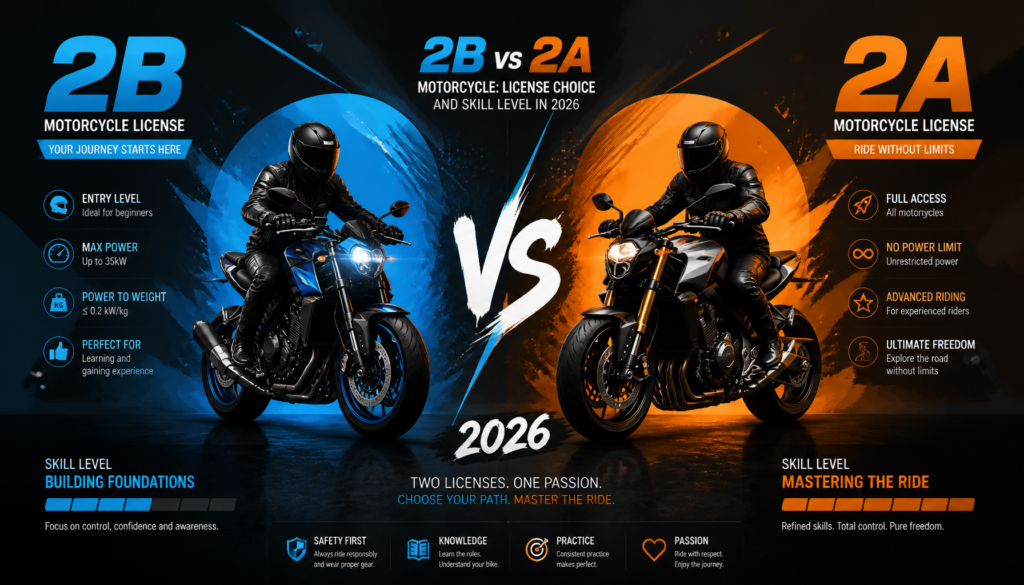
2B vs 2A Motorcycle: Most riders feel that moment of doubt before moving up from one license stage to the next. If you are choosing between a 2B vs 2A Motorcycle license in 2026, one wrong step can leave you feeling stuck or overmatched. The right choice should fit both your current control, confidence, and road plan, not just your excitement for a bigger bike.
This article will clear the confusion around license choice and skill level. We will explain what each license level covers, how their limits affect what you can ride, and why your experience level should guide your decision more than your wish list. You will also learn how riders can move forward in a safe way, with a practical path that builds skills before opening more doorways. You will finish with a clear view of where you stand, what to target next, and how to avoid costly retraining delays. Whether your goal is a gradual climb or a direct move toward wider riding freedom, we start by comparing 2B and 2A in plain terms.
2B vs 2A Motorcycle License in 2026: Which Class Fits Your Riding Future?
2B vs 2A Motorcycle: When people compare 2B vs 2A Motorcycle licensing, the real question is not just power, it is legal readiness for where they want to ride in 2026. If your short-term goal is confidence-building commuting or early-stage weekend rides, this is usually where 2B fits best. If your goal is high-capacity, faster touring or advanced weekend performance riding, 2A often becomes the practical long-term class. The key is matching the class to your current skill, body confidence, and lifestyle, then planning your upgrade path, instead of jumping too early.
| Decision Factor | 2B Licence | 2A Licence |
|---|---|---|
| Legal intent | Entry-to-intermediate motorcycle rights for smaller to moderate-capacity performance range (exact limits vary by country/region). | Broader access to higher-capacity, higher-power bikes after meeting stricter eligibility and training criteria. |
| Typical handling profile | Easier-to-manage weight and power for developing smooth throttle and corner entry habits. | Higher power-to-performance envelope with stronger acceleration and greater top-end potential, which demands tighter control. |
| Required skill set | Good for riders focusing on basic control: braking, lean-in confidence, and traffic awareness. | Needs stronger anticipation, advanced throttle modulation, and more precise braking and balance transitions. |
| Cost and ownership | Often lower purchase and insurance baseline for new riders, with simpler maintenance confidence. | Typically higher running cost potential due to stronger machines, wider coverage claims history impact, and usage context. |
| Best use cases | Urban commuting, short distance rides, learning progression, and mixed beginner-friendly group runs. | Longer touring distances, stronger performance ambitions, and experienced rider use cases. |
| Upgrade timing | Strongly recommended for riders in dense city or tight budget use-cases before scaling up. | Recommended once skills, discipline, and confidence are stable after consistent 2B-level riding. |
Because local laws differ, always verify exact age, training, and step-up requirements with your local licensing authority before booking classes. Some regions enforce staged progression or additional testing before a full 2A endorsement, so treat the upgrade as a planned investment rather than a rush. For many riders, especially in cities with heavy traffic and limited storage, this staged route also lowers risk and total cost while preserving confidence.
If your immediate need is dependable daily mobility, choose the class that lowers intimidation and supports consistent practice. If your riding future includes distance touring, mountain roads, and sustained speed work, a plan to progress into 2A makes sense once your skills are consistent. In short: start where control is realistic, ride enough to prove consistency, then upgrade. That is the safer and usually cheaper route to a confident, legal long-term licence decision.
Understanding 2B vs 2A Motorcycle License Classes: Eligibility, Access Limits, and Category Boundaries
2B vs 2A Motorcycle: When comparing 2B vs 2A Motorcycle license classes, the real choice is about the legal scope that matches your current skills and goals, not simply power. In many licensing pathways, 2B is the next practical step after learner-level status, while 2A is positioned as a broader category for riders with more demonstrated experience. That staged structure protects new riders from a jump into machines and traffic situations they are not yet comfortable with, while still giving a clear route to wider access.
Minimum age, medical fitness checks, and training/test requirements can vary by jurisdiction, so treat these as your baseline before you buy anything. A common pattern is still a provisional pathway: proof of road knowledge, practical testing, then progressive category privileges as competence and exposure increase. The medical and experience checks are usually not optional; they are designed to prevent unsafe progression. Planning your purchase around those gates helps avoid a bike that you cannot legally ride right after the test day.
| Comparison point | 2B | 2A | Practical meaning |
|---|---|---|---|
| Position in the licence ladder | Typically after learner/entry stage, before unrestricted exposure | Typically above 2B where law permits broader power/size access | Shows a progressive learning path rather than one-step jumping |
| Access limits | Restricted to a defined motorcycle group within this class | Allows access to a wider range than 2B | Better matched to rider growth and risk tolerance |
| What is usually required | Core training + testing + eligibility checks | Higher-tier checks, test criteria, and eligibility confirmation | Expect additional validation before upgrading |
| Relation to learner/intermediate | Often the first intermediate-level legal access stage | Usually the next intermediate-to-advanced step | Useful for riders needing smooth progression in dense urban traffic |
| Common progression trigger | Completed learner constraints + documented experience | Stable riding record and readiness to handle bigger performance margin | Build on confidence first, then unlock more machine choice |
This matters at purchase time: if your immediate need is commuting, confidence building, and predictable daily use, 2B tends to be the practical starting point. If your route includes longer rides or larger touring-capable bikes, plan an upgrade path toward 2A once you have met local training and medical milestones. For many riders, a staged approach also helps with local enforcement realities, insurance interpretation, and resale confidence because your upgrade path shows responsible ownership habits before high-capacity ownership.
Quick Specs: 2B vs 2A Specs at a Glance
2B vs 2A Motorcycle: When comparing a 2B vs 2A Motorcycle decision in 2026, quick specs matter as much as engine excitement. Riders often underprice legal complexity and then face expensive corrections later. Use this table-first view to match category rules with budget, local regulation, and your actual riding routine before your final purchase.
- The middle columns show class-level patterns; actual legal and insurance numbers are region specific.
- For machine-check clarity, treat this as a comparison baseline and then confirm everything with your official licensing authority, test centre, and insurer.
| Category | 2B | 2A | Official/Regional Check |
|---|---|---|---|
| Licence Class | Entry-level motorcycle category, typically tied to smaller-capacity riding and first-step qualification. | Broader category aimed at more mature motorcycle access and larger-capacity operation. | Confirm exact class definitions with your local road authority or transport ministry. |
| Eligibility Conditions | Designed as the normal starting class for new riders once base legal requirements are met. | Usually linked to stronger qualification expectations and full-category competency confidence. | Age, medical, and progression rules differ by region and are legally enforced. |
| Allowed Engine Capacity | Typically narrower and lower-capacity envelope for manageable power and handling. | Typically wider and higher-capacity access for experienced control and use-cases. | Use official authority tables for exact displacement thresholds by country/region. |
| Typical Power Limits | Usually constrained to support progression and confidence for earlier stage riders. | Usually allows stronger power delivery compared with the entry category. | Power-limit values, if published as kW/HP bands, are authority-dependent. |
| Typical Riding Scope | Best for urban commuting, training, and practical daily use. | Often selected for mixed commuting, touring, and performance-oriented routes. | Local enforcement patterns and licensing guidance shape practical usage expectations. |
| Testing Requirements | Foundational practical and theory checks for safe baseline control. | Expanded practical confidence tests that reflect larger-motorcycle handling demands. | Review your region’s current test syllabus and upgrade process directly. |
| Insurance Profile | Often aligned with beginner risk assumptions and smaller-claims patterns. | Often priced with stronger attention to performance and rider responsibility profile. | Request written quotes, and compare how insurers map class and rider history in your market. |
| Typical Rider Profile | New riders, practical city users, and owners with tighter storage or commuting constraints. | Experienced riders, confident highway riders, and those planning stronger long-route performance use. | Rider profile scoring is localized; verify underwriting criteria for your exact region. |
This spec snapshot is built to remove guesswork for buyers in both safety and budget-sensitive situations. If your ride is short-distance and policy cost matters, start with the 2B path and add skill confidence first. If your local routes and lifestyle demand bigger performance headroom, consider 2A earlier—but only after checking regional test requirements. Either way, a fact-based comparison avoids costly upgrades and supports a cleaner upgrade path when you are truly ready.
Engine Capacity and Performance Differences Between 2B and 2A Bikes
2B vs 2A Motorcycle: In the 2B vs 2A Motorcycle comparison, the practical difference starts with the legal and performance envelope. While exact limits vary by country, 2B machines are generally designed around lower engine capacity and gentler output profiles, while 2A licenses allow higher-capacity, higher-power riding. That distinction directly changes how a bike feels at the throttle, how it behaves in traffic, and how confidently a rider can plan overtakes or sustained high-speed travel.
In real city and suburban use, 2B engines usually deliver manageable acceleration. The power arrives progressively, which helps beginners and commuters control wheelspin, traction, and rear-end movement on imperfect road surfaces. For stop-start traffic, this smooth character often reduces stress and can improve consistency, especially in mixed-speed urban traffic where quick, repeatable throttle inputs matter more than brute force.
By contrast, 2A class bikes are typically stronger at the same engine speeds. This usually means stronger throttle response and better overtaking confidence, especially when lane changes happen on short notice. On highways, higher top-end potential and stronger midrange pull can make passing safer and more comfortable, especially on busy roads where staying with flow is part of defensive riding rather than aggressive riding.
2B vs 2A Motorcycle: Weight and frame behavior also matter. Larger-capacity 2A bikes can feel more planted as speed rises, but they often ask for more deliberate braking, corner entry, and body control. Smaller 2B platforms usually shift direction more quickly, which is useful in technical city lanes, tight urban corners, and riders who are still building lean-angle consistency. That is why many riders choose 2B first if licensing progression, commuting storage constraints, or apartment parking favor a compact, easy-to-handle machine.
- City commuting: shorter trips, heavy traffic, and low-speed handling usually favor 2B responsiveness.
- Touring: riders doing longer highway stretches often appreciate 2A for sustained speed margin and relaxed overtaking.
- Weekend performance riding: stronger acceleration and top-end pull make 2A more fun on open roads, while still demanding smoother inputs.
Use this as your buying lens: if your riding calendar is mostly daily urban commutes plus occasional weekend use, 2B often wins on ease and confidence. If your plan includes frequent motorway cruising, group rides, or stronger two-up loads, stepping into 2A may offer the extra performance reserve you actually need. Matching the class to your current skill level and route profile first makes the eventual upgrade far less risky and more satisfying.
Riding Experience and Skill Requirements: Why 2B Is Usually the Safer First Step
2B vs 2A Motorcycle: In a 2B vs 2A Motorcycle decision, most learners underestimate the practical skill jump between license classes and focus only on power. In practice, the core difference is not just engine size but the margin for correction. For beginners, a 2B bike is usually the safer first step because smaller step-up power makes throttle mistakes less punishing and gives new riders more time to think. That extra control time often aligns better with the way rider eligibility rules are designed to build competence progressively.
Throttle control is the first gate. On a lighter 2B-style machine, smooth roll-on gives cleaner feedback, while larger 2A bikes can punish abrupt inputs with abrupt wheel spin, instability or rear lift. Trail braking is similar: on lower output bikes, combining gentle front brake pressure while leaning is easier to learn progressively. With more performance available in 2A, riders often carry too much brake too long, then need an emergency correction that exceeds their current reflex discipline.
Emergency braking distance is where many riders discover the real gap. A beginner on a higher-powered machine may expect equal stopping feel at low speed, but heavier mass and stronger deceleration response create larger effective stopping demands. Learning to stabilize the bike before the final squeeze, then complete a controlled stop, is easier to practice on 2B first. In dense urban traffic, this becomes critical because short headways and unpredictable cut-ins require repeatable brake modulation plus forward planning.
2B vs 2A Motorcycle: Body position and weather recovery margins are the other reliability test. In wet conditions, the wrong body input can overwhelm traction quickly, especially on a stronger throttle, while a 2B setup usually forgives imperfect shifts in line and pressure. Riders who progress too quickly into high-output machines often make the same error pattern: chopping the throttle mid-corner, locking brakes late, or sitting upright too long in transitions. Overconfidence in straight-line acceleration often leads to late entry speed on bends, which then forces abrupt, error-prone corrections.
Common mistakes on overpowered machines usually cluster around:
- Throttle overuse at corner exit.
- Braking too late and too hard, increasing panic-stop distance.
- Leaning into turns with poor body position and delayed weight transfer.
- Skipping hazard scanning in traffic, hoping for more power.
- Skipping wet-weather recovery practice and then trying quick stand-up or steering corrections.
Before moving from 2B to 2A, make these skills non-negotiable: consistent trail braking at legal speeds, repeated smooth emergency-stop drills, reliable corner exits without rear-wheel spin, active traffic scanning, and recovery routines on low-traction roads. If these are not stable, the next class upgrade is usually a risk, not a reward. Choose the class that matches your current control level, then upgrade only when your riding behavior is consistent.
2B vs 2A Ownership Cost Comparison: Purchase Price, Insurance, Fuel, and Maintenance Realities
2B vs 2A Motorcycle: When buyers evaluate the 2B vs 2A Motorcycle ownership decision, the most important question is not just the ride feel but the recurring cost burden over 12–24 months. In most markets, a 2B-licensed rider usually lands in a lower entry-cost zone, while a 2A path often lands in a higher power-capability lane that can influence purchase and operating costs. If your goal is reliable mobility, this can matter more than peak acceleration in day-to-day budgeting.
Across the budget categories, this comparison is usually shaped by three practical factors: legal positioning (licensing and risk class), expected usage, and local storage/use conditions. In cities with tight parking, shared roads, and heavy commuter mileage, a slightly lighter operating profile can save money; on longer tours, higher power 2A machines can offset some costs through different ride efficiency and trip-time convenience.
| Cost category | 2B tendency | 2A tendency | Ownership impact (12–24 months) |
|---|---|---|---|
| Purchase band | Usually lower initial spend because machines in this licence step are commonly positioned as entry-level rider models. | Usually higher, reflecting broader performance and power potential at launch. | Lower upfront cash pressure can make first ownership smoother and easier to finance. |
| Insurance & underwriting | Generally lower risk loading for newer riders or smaller-displacement classes tied to the licence tier. | Often higher insurance scrutiny due to greater machine capability and class/engine implications. | Can become a major recurring expense; request quotes early with your postcode, age band, and licence class. |
| Fuel efficiency tendency | Commonly better for stop-start urban riding and mixed commuting. | May use more fuel in aggressive or high-speed use. | Small efficiency differences compound over time on regular commuting routes. |
| Maintenance and parts cycle | Generally lighter servicing burden and easier accessory budgets for many beginner-focused models. | Can involve more complex servicing expectations and higher parts or accessory spend. | Over two years, maintenance realism matters more than hype when budget consistency matters. |
| Resale & liquidity | Often broader buyer interest among value-seeking first-time owners. | Stable demand for capable machines can help retention in enthusiast-heavy segments. | Liquidity affects how easy it is to switch platforms if your ride goals change. |
For daily commuting, especially under tight work schedules and budget constraints, 2B bikes usually give better total-cost predictability. For frequent long-distance or higher-speed travel, 2A can become practical if time-on-road is a priority and you can absorb higher insurance and maintenance variance. The wisest move is to map mileage, storage, and upgrade plans before buying.
- Ask insurers how your exact age, city risk area, and licence class change premiums.
- Estimate service and accessory spend from your planned mileage, not your dream mileage.
- Build a simple 24-month cash flow estimate; if it fits before lifestyle upgrades, the purchase is easier to justify.
That framing turns a 2B vs 2A comparison from emotion into a decision: buy for reliability first, then performance if your budget and road use prove you need it.
2A vs 2B vs A2: The Closest Category Comparison Before You Upgrade
2B vs 2A Motorcycle: If you are planning a ride upgrade in 2026, the most useful question is rarely just performance; it is whether your next step is controlled growth or a jump. In the 2B vs 2A Motorcycle decision, 2B, 2A, and A2 form a practical sequence for most first-time upgraders. Think in terms of legal rights, training readiness, and your annual riding plan before you commit to a bigger bike.
Licences such as 2B and 2A sit in a legal framework that separates them by allowed riding power and category limits, which is why they differ from lower classes and from more open categories. If you are still consolidating experience, this is not about ego; it is about matching your documented skill level to what regulations allow. Before swapping categories, confirm local requirements for age, experience history, and mandatory courses, because these rules can change by region and can delay an otherwise ideal purchase.
That is where 2A vs 2B vs A2 becomes a real comparison. Many riders use A2 as a stepping-stone: more freedom than 2B but still less abrupt than 2A, which can make the training transition smoother for weight, braking, and throttle transitions. Going straight from 2B to 2A can feel steep in dense city traffic if your route includes frequent starts, stops, and lane changes.
2B vs 2A Motorcycle: From a skills-per-spend perspective, 2B often gives the best value to new buyers. It generally supports calmer learning on practical roads, and its day-to-day usability can keep maintenance, insurance, and operating confidence in balance while you build fundamentals. For many budget riders, that is exactly the point where money is better spent on protective gear and coaching rather than on the very first high-output upgrade.
Performance-focused riders usually favor 2A once their technical baseline is stable. Greater performance envelope usually means stronger acceleration, fuller top-end confidence, and a machine that feels less restricted for highway or enthusiast riding. The trade-off is greater control demand: heavier mass, stronger braking forces, and sharper throttle response all require cleaner technique and more deliberate training.
So which path fits you? If commuting, short commutes, and a tight budget define your buying pattern, build a solid 2B base and upgrade only after repeated, consistent riding practice. If your longer-term goal is touring comfort plus performance upside, plan your route around A2 as an intermediate checkpoint before 2A. That progression protects legal compliance, improves value-for-skill, and keeps your upgrade decision financially and technically justified.
2B vs 2A Motorcycle Buyer Concerns in 2026: Local Rules, Storage, and Upgrade Timing
2B vs 2A Motorcycle: If you are comparing a 2B and 2A path this year, the first variable is rarely the bike itself. In many regions, buyers are seeing local licensing rules shift, and test booking windows can stretch unpredictably. Before purchasing, confirm the current eligibility and exam process with your transport authority, because a delayed 2A upgrade can leave a new rider with a bike they cannot legally ride, while a well-chosen 2B machine keeps you legal and riding.
For most riders, the practical distinction is confidence and control before complexity. A 2B licence category is generally aimed at lighter, lower-capacity, easier-to-manage motorcycles, while 2A opens the door to larger engine capacity and higher performance potential. In a 2B vs 2A Motorcycle mindset, this means 2B is usually the faster way to gain real-road experience without being overwhelmed by weight, throttle response, and stronger braking demands.
Use this buyer matrix before you buy:
- Experience: If you are new or just building comfort in traffic, start with 2B and focus on smooth clutch, braking, and corner discipline before moving up.
- Storage: City apartments, basement parking limits, or shared garages usually favor 2B-sized bikes for easier parking, handling, and easier day-to-day storage planning.
- Lifestyle: If your primary use is commuting, errands, and short weekend rides, 2B often delivers lower stress and better practicality; if you consistently do longer routes with highway segments, 2A flexibility becomes more attractive.
- Family use: Riders carrying family-related gear or planning group travel should assess comfort first, since bigger bikes can feel less forgiving when loaded and in stop-go city traffic.
- Budget and operating costs: Purchase outlay, insurance tiering, and servicing complexity usually increase as you move toward higher-capacity 2A-capable machines, even before fuel use becomes a daily concern.
Local incentives and ownership habits matter, too. In some markets, entry-level commuters get easier access to financing, parking, or rider courses when staying in 2B early; in others, families choose 2A-ready goals from the start if long-distance travel is central. Either way, buy to your reality, not to forum hype.
Most riders should upgrade to 2A when three things align: proven comfort in adverse traffic, consistent control over a broader power band, and confidence that their storage and budget support the heavier ownership load. If not, staying on 2B longer is not a delay—it is often a smarter route to safer progress, lower anxiety, and a smoother upgrade experience once rules, exams, and timing line up in your favour.
Our Verdict: Should You Choose 2B or 2A Right Now? (And the Best Next Step)
2B vs 2A Motorcycle: Our verdict on the 2B vs 2A Motorcycle decision is practical: start with 2B unless your riding goals, confidence, and legal readiness already point clearly to the next level. The biggest reason is control. New riders usually benefit from a category that focuses on manageable power delivery, simpler handling, and a lower-risk daily routine. From a budget, insurance, and stress perspective, that usually means a smoother start and better long-term retention of safe habits.
That said, 2A is not “too much” in every case. If your plan includes longer rides, stronger performance needs, or heavier touring expectations, the additional performance envelope of a larger-class bike can make sense later on. The difference between the two classes is not just paperwork: it reflects engine capacity limits and the way the bike behaves under acceleration, braking, and high-speed flow. Bigger bikes tend to demand finer throttle control and stronger decision speed, especially in mixed traffic and on open roads.
Use this simple ladder when choosing your path:
- Beginners: stay on 2B while you build consistency, especially for commuting, city traffic, and school/work-to-workday use.
- Advancing riders: move toward 2A when your personal goals include frequent higher-speed travel, expressive riding, or larger-capacity machines.
- Safety-first riders: upgrade only after a measurable milestone, such as completing structured training feedback and demonstrating stable control in advanced manoeuvres under instructor assessment.
Cost and practicality are part of the same decision. Many riders in practical local markets choose lower-commitment ownership first because 2B-ready machines are often easier to fit into day-to-day storage, parking, and commuting schedules. Then they step up when lifestyle truly changes, not just when curiosity rises.
The strongest move is not to guess your class by emotion. Confirm your local category rules first, because age, eligibility windows, and test access differ by country and even region. Then book your training and tests, keep your upgrade goal documented, and choose the bike that matches your next legal step rather than the loudest dream bike in the showroom.
We at Speedzone specialize in offering top-quality servicing for a variety of premium motorcycle brands. Whether you ride a Yamaha, Honda, KTM, Suzuki, Kawasaki, SYM, Aprilia, Piaggio, or Mutt Motorcycle, you can trust us to keep your ride running smoothly.
Book Your Service Today
Ready to give your motorcycle the care it deserves? Or just curious to know more? With our premium motorcycle accessories available catering to every motorbike models. Book your motorcycle servicing with us or drop by our showroom today and experience the difference of expert servicing tailored to your brand and friendly staffs!
