
Electric vs Petrol motorcycle, Electric bikes, Electric Motorcycles, Electric Scooters vs Motorcycle Scooters
Electric Motorcycles: Costs, Range, and Charging vs Petrol
Aug
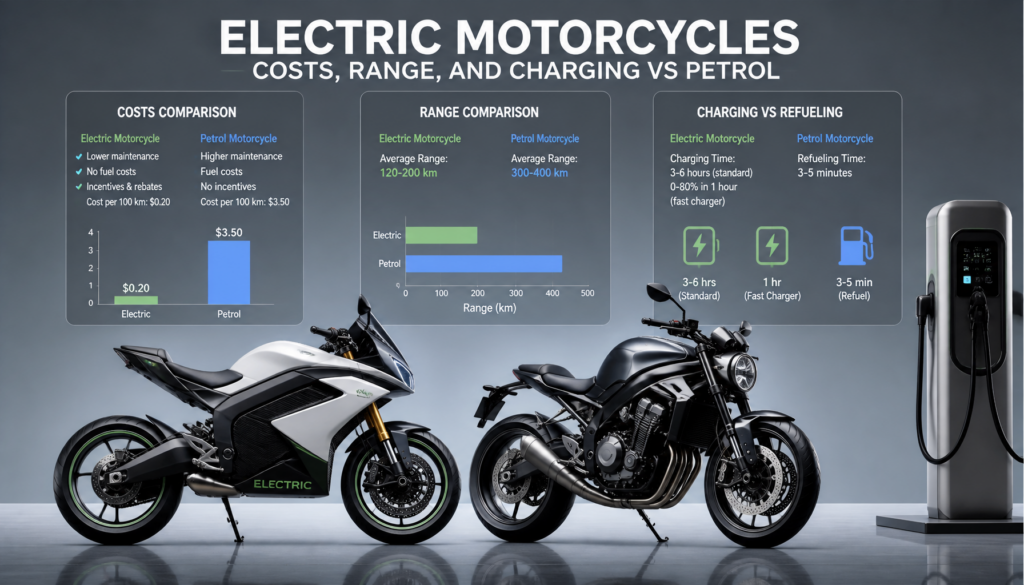
Electric Motorcycles: Confused by Electric Motorcycles – Costs, Range, and Charging vs Petrol (2026)? You are not alone. Many riders ask the same thing: can electric really replace a petrol bike? This is a big move, especially if you rely on your bike every day.
This guide keeps it simple. We will compare what you pay at purchase, what costs come each month, and where hidden expenses can appear. Then we will test range from real world rides, including short stops, traffic, and road habits that affect how far you can go. We will also cover charging timing, charger access, and when it helps and when it slows your ride. By the end you can see where electric is a strong fit and where a petrol bike still makes more sense for your routine and budget. Let us start with the full cost picture and then move to range and charging in plain terms.
Electric Motorcycles in 2026: Are They the Future of Everyday Riding?
Electric Motorcycles: Are Electric Motorcycles in 2026 really the right choice for everyday riding, or is the petrol bike still the safer bet? This section is for commuters, city couriers, weekend riders, and performance-oriented riders who are actively deciding where to put their money next. We will keep this practical: how electric bikes work, what ownership feels like in real life, where they still struggle, and what to do before you buy in 2026.
If you use a bike every day, start by defining your use case. Urban commuters want predictable short-to-medium daily distance, easy parking, and low running effort. Delivery riders care about frequent stop-and-go efficiency, easy recharging around your route, and less vibration during long shifts. Weekend riders usually want flexibility for mixed roads, while performance users care about throttle response and power delivery more than anything. This matters because the right answer is not one-size-fits-all.
For your decision framework, understand the core system first: an electric motorcycle uses an electric motor and battery pack, with energy restored through a charging session rather than fuel station fills. The power delivery feels immediate and usually smoother than a combustion engine, while acceleration is often linear and controlled. In everyday traffic, this can make launches feel more effortless and reduce rider fatigue.
Electric Motorcycles: Compared with traditional petrol bikes, the ownership picture shifts. Running costs and routine maintenance are generally lower for electric models because there is no engine oil, spark system, exhaust tuning cycle, or fuel logistics to manage. They are quieter, emit less over-road pollution, and can feel cleaner in dense neighborhoods where riders value comfort for nearby neighbors. If your local area has strict urban emissions rules or parking/charging incentives, these advantages become stronger.
Challenges are real and should not be ignored. Riding range is still usually lower than petrol in similar conditions, and charging time plus charger access can alter your schedule. Storage constraints are also common: apartment dwellers need dependable home charging, and shared workspace riders need nearby charging points. Add the higher upfront cost, plus possible battery ageing and replacement questions, and your case becomes more than just “cool tech.”
That said, the direction is clear. Battery capacity, charging speed, motor performance, and smart connectivity are all improving, and infrastructure adoption is growing each year. So, should you buy now? Yes, if your routes are mostly city-based, you can plan charging around work or home, and you value low operating costs over petrol-like range confidence. If you are a long-distance or all-weather performance rider, wait for your route and usage model to be fully confirmed before switching.
In short, Electric Motorcycles are not automatically better for everyone in 2026, but they are often better for specific routines. Use your own commuting distance, charging access, and use-case constraints as your compass and you can make a calm, confident purchase decision instead of an emotional one.
How Electric Motorcycles Work: Motor, Battery, and Charging Fundamentals
Electric Motorcycles: At the center of modern two-wheeler buying decisions, Electric Motorcycles are powered through a compact system of motor, battery pack, and electronics rather than a full combustion stack. Unlike petrol bikes, there is no ignition, crankshaft, or exhaust cycle, which is why the ride generally feels smoother and quieter in stop-start traffic. That smoothness is not just comfort—many owners report it translates into easier daily control, lower stress, and more confidence in short commutes where consistency matters. It is one reason these bikes are increasingly discussed for city use despite still-evolving infrastructure.
The motor creates movement when electrical current is sent through it in a controlled pattern. A power controller sits between your right-hand input and wheel force, interpreting throttle position and managing output many times per second. With this electronic control, torque delivery tends to feel immediate and linear, while a traditional petrol layout often depends on engine rev range and gearing changes to build usable pull. That difference explains why electric motorcycles can feel predictable from low speed to acceleration, especially in dense traffic.
Electric Motorcycles: The battery pack stores the energy and determines how far you can comfortably travel between charges. It also sits at the center of two common buyer concerns: real operating range and long-term battery replacement cost. Real range varies because each ride applies different demand, and because battery condition and thermal management influence efficiency over time. That is why official distance claims should be treated as a baseline, then adjusted for your own route pattern and charging habits.
- AC home charging is typically used for routine overnight top-ups, making it ideal when you can charge where you park and leave the bike ready each day.
- DC fast charging is used for quicker energy replenishment on the move, useful for longer trips but dependent on compatible station access and travel planning.
Regeneration adds one more practical layer: regenerative braking can return some energy to the battery during deceleration, which helps in urban flow rather than highway cruising. If your home storage setup is limited, local charging access becomes a deciding factor as much as battery specs. For buyers evaluating the switch, the strongest objection is often charging time versus convenience—and that is usually resolved by matching your routine to AC home charging first, then using DC only where needed. For many commuters and short-to-mid distance users, this workflow is enough to justify a purchase now; for high-mileage touring, it is still smarter to compare routes, infrastructure, and total cost expectations before deciding.
Quick Specs: Electric Motorcycles vs Petrol Motorcycles at a Glance
Electric Motorcycles: If you’re comparing in 2026, this quick glance is built for buyers who want clarity before buying a motorcycle. The key question is not always top speed, but whether the machine fits your routine, route, and budget. Use the table below as a practical filter for ride style, maintenance patience, and how you refuel or recharge. Electric Motorcycles can be a smart choice when your usage is predictable, while petrol bikes can still be the practical option in other scenarios.
| Criterion | Electric Motorcycles | Petrol Motorcycles | Buying Impact |
|---|---|---|---|
| Drivetrain type | Battery + electric motor, simplified drive path | Internal combustion engine + fuel system | Electrical drivetrains can feel simpler to live with day to day. |
| Power delivery behavior | Instant torque, smooth pull | Torque rises with engine revs | Electric power feels easier in traffic starts. |
| Battery / engine size class | Battery class sets range and weight | Engine class sets performance and fuel behavior | Match class to payload and expected road demand. |
| Refuel or recharge method | Charge at home, work, or public points | Fuel stations and pump-style refill | Charging access can influence day-to-day convenience. |
| Maintenance touchpoints | Fewer routine service points | More frequent mechanical and fluid checks | Lower routine maintenance can reduce interruptions. |
| Expected range profile | Model-dependent, varies by load and pace | Varies by riding condition and load | Model, riding style, weather, and load can shift outcomes. |
| Refuel / recharge time | Recharge cycle is generally longer | Fuel fill is usually quick | Plan electric charging windows in advance. |
| Noise levels | Very low operational noise | Higher mechanical noise | Quiet operation helps in dense neighborhoods. |
| Ownership cost drivers | Higher upfront cost, lower daily running, battery lifespan planning | Lower entry price, higher ongoing fuel and service spend | Compare lifecycle expense, not sticker price alone. |
| Emissions impact | Zero tailpipe emissions | Combustion emissions during use | Urban regulations and air-quality expectations can improve electric value. |
Your local buying behavior matters: if you have secure charging access and stable parking, the lower operating burden of electric ownership can be compelling. Where charging points are limited or your schedule is unpredictable, a petrol option may reduce planning stress. Consider these practical constraints as carefully as headline efficiency.
If your ride is mainly commuting, errands, and short city loops, the practical benefits of electric often outweigh concerns. For frequent long-distance travel, check route planning carefully and test real-world range under your climate and load before deciding. When you compare both platforms this way, you move from brand hype to a confident purchase decision you can trust.
Electric Motorcycles vs Petrol Bikes: Total Cost, Reliability, and Performance Comparison
Electric Motorcycles: When you compare Electric Motorcycles with petrol bikes, the right question is total ownership, not just list price. One-time costs include purchase, registration, financing, and any charging setup at home or work. In the first 12 months, running cost usually becomes more predictable for riders who track monthly distance, because energy and routine service inputs are more stable than fuel-price swings. For buyers in cities, that predictability can make total budget planning easier than it sounds.
On reliability, the two platforms differ mostly in where complexity lives. Electric systems usually reduce engine-and-fuel-system routine interventions, while shifting attention toward battery pack health, thermal management, and software/firmware upkeep where supported by the maker. Petrol bikes, meanwhile, keep a familiar mechanical maintenance rhythm and usually a broad independent service footprint. In practical terms, that means lower scheduled mechanical complexity for many electric users, but stronger trust needs around battery care and dealer capability.
Performance is often compared by throttle response, acceleration feel, and confidence on daily routes. Electric delivery is commonly smoother and quieter, with immediate drive response that can feel effortless in stop-and-go traffic. Petrol machines still offer the engine-character profile many riders prefer, especially when blending throttle modulation with long miles. Trip planning friction is where both diverge: charging duration and station availability affect spontaneous rides, while petrol users still plan around station density differently on less predictable routes.
| Area | Electric Motorcycle Profile | Petrol Motorcycle Profile | 12-Month Cost Inputs (No numbers to invent) |
|---|---|---|---|
| One-time cost | Higher upfront equipment and possible charger setup | Often lower sticker entry, sometimes quicker to buy | Purchase/lease price, financing, registration, accessories |
| Fuel/electricity | Electricity usage based on distance | Fuel usage based on distance | Monthly km × consumption rate × local unit price |
| Service intervals | Fewer engine-related consumables; battery checks are key | Regular periodic fluid and wear maintenance | Service cadence, expected labour, tyres, consumables |
| Performance feel | Linear, quiet acceleration; low mechanical vibration | Traditional throttle and rev behavior | Subjective comfort score or route satisfaction notes |
| Trip planning | Charge-time and charger availability become part of route planning | Fuel refill easier in many areas but still route-dependent | Planned monthly distance, backup contingency plan |
| Resale/upgrade | Battery aging perception and warranty coverage matter | Established secondary market familiarity | Expected resale timing, battery warranty, upgrade cycle |
Electric Motorcycles: To run the model, start with your local electricity tariff and fuel price, keep distance assumptions fixed, and then total monthly cost = energy + maintenance + insurance + financing. Multiply the monthly sum by 12 and compare your two versions side by side before adding trip-planning friction and storage constraints. This gives you a realistic decision base instead of a single headline price quote.
If you depend on apartment parking, verify charging permissions and safety controls before buying, because practical charging access can be the make-or-break factor. Also check local EV policies, tariff structures, and any incentives for registration or workplace charging because they can materially shift the balance. Build these checks into your purchase checklist, and you will move from uncertainty to a confident switch or a better-fit petrol-backed choice.
Benefits That Matter Most: Why Electric Motorcycles Reduce Running Costs and Improve City Mobility
Electric Motorcycles: When comparing transport options for daily work trips, the first thing people notice is cash flow. In city traffic, rides are often short, stop-and-go, and repetitive, which is where Electric Motorcycles can deliver strong value. Running on electricity usually gives a steadier operating pattern than a petrol-powered motorcycle, because there are fewer hidden fuel spikes between tank fill-ups. For riders who track monthly mobility spend, this predictability is often the clearest signal that electric is the smarter value choice for city life.
Another major advantage is lower running costs plus reduced routine maintenance. Petrol motorcycles need service cycles linked to fuel engines and related wear, while electric drivetrains have simpler ongoing care requirements and usually fewer high-wear moving parts in everyday urban use. That can mean fewer surprises, fewer missed workdays, and fewer interruptions during busy delivery windows. If reliability and predictable budgeting matter most, this practical reliability gain helps remove a lot of purchase hesitation.
Electric Motorcycles: City mobility improves further through reduced emissions and quieter operation. In areas where local authorities are tightening noise or air-quality expectations, cleaner streets and less acoustic stress are not abstract advantages—they affect real life. The smoother acceleration of electric power delivery also helps at junctions and stop-start lanes, making frequent launches feel less abrupt than in many combustion bikes. This directly improves comfort on routes full of traffic lights and congestion.
These benefits stack most strongly in use-cases you can identify quickly:
- Urban commuting: fixed routes and predictable stop-light patterns make lower running costs and smooth response compound over time.
- Short delivery routes: repeated acceleration, braking, and low-speed crawling are exactly where electric comfort and efficiency shine.
- Parking-restricted living: apartments or tight garages benefit from cleaner operation, lower noise, and a simpler start-stop routine.
If you are still deciding, start with your real-day pattern and where you can charge. If your miles are mostly local and your charging access is steady, this is usually the strongest case for switching now. If your use is mostly long-distance riding, range and charging time should remain part of your shortlist while you choose. For city mobility, though, the value proposition is clear: less friction, cleaner streets, and smoother daily riding that often leads to a confident purchase decision.
Buyer Concern Deep Dive: Charging, Storage, Local Rules, and 2026 Subsidy Opportunities
Electric Motorcycles: The biggest practical worry for buyers of Electric Motorcycles is not styling or speed—it is daily usability. You may love lower running costs, cleaner operation, and smooth acceleration, yet still hesitate when you think about charging, storage, and rules you did not grow up with around petrol bikes. The right move is to treat the purchase like a household planning decision, not just a motorcycle test ride.
Start with honest range planning. Electric motorcycles typically have less riding range than traditional petrol bikes, so estimate your weekly mileage based on real routes, not ideal trips. Include school runs, errands, and the occasional detour, then add a buffer for one unexpected day. If your routine is predictable and mostly local commuting, this step usually confirms whether an electric option can truly replace your current vehicle without creating stress.
Charging is where most people either gain convenience or lose trust. Overnight or home charging is usually the smoothest setup, but many buyers forget to verify whether that option is realistic where they park. If you live in a shared building or rent, confirm in advance if you can install and use a dedicated outlet, and whether the property’s electrical setup can support regular charging safely. If you do not have reliable access, plan around public chargers and confirm travel feasibility, especially because charging time and station availability remain major challenges.
Electric Motorcycles: Battery-safe storage is another overlooked step. Ask where the bike will be kept when not in use: a secure, lockable, weather-protected space reduces risks and helps maintain confidence around battery health. For urban buyers, this often matters more than expected power or dashboard features. It also protects resale value and lowers the chance of misuse or theft in dense parking environments.
Before purchase, complete a pre-buy checklist:
- Map your worst-case weekly riding distance and compare against expected charging cycles.
- Verify home or workplace charging access, not just showroom promises.
- Confirm local registration and parking rules for electric motorcycles in your city or state.
- Check whether secure overnight parking is available for battery storage.
- Review who handles battery replacement concerns and service support.
- For 2026 buyers, confirm current subsidy, rebate, tax credit, or utility incentive eligibility on official portals before booking.
If these points are mostly clear, you are in a strong position to move forward. If any key item is unresolved, delay the purchase until it is resolved—especially with Electric Motorcycles, because convenience and compliance usually matter more than one-time excitement. This disciplined approach reduces regret and turns uncertainty into a confident switch.
Who Should Buy in 2026? Use-Case Match + What Future Updates May Change
Electric Motorcycles: In 2026, choosing the right buyer profile is the fastest way to decide whether Electric Motorcycles make sense. Not everyone needs a deep engineering breakdown; most riders should evaluate trip length, where charging is possible, and whether lower operating costs matter more than outright range. The strongest buying decision starts with matching your routine to the technology, not fitting your routine to a trend.
For daily city commuters, the match is strongest. Electric motorcycles usually deliver smoother acceleration, quieter operation, and lower running and maintenance costs, which suits stop-and-go traffic and short to medium commutes. If you can charge at home, at work, or both, this profile often sees immediate practical value.
- City commuter: Best-fit today for predictable daily mileage and predictable traffic patterns. The current advantage is convenience and lower running cost, while the main limitation remains charging availability and range planning.
- Long-distance rider: This profile can still struggle now due to limited riding range compared to petrol motorcycles. On occasional long trips, charging time and station coverage can slow the journey, so this rider should treat now-buying as a conditional decision.
- Performance rider: Quick torque and smooth power delivery already make these bikes compelling for city bursts and twisty roads. Still, for repeated high-speed or extended aggressive riding, battery endurance and recharge cycles should be weighed carefully.
- Family-run errands: Quiet operation and easy handling can be excellent for school runs, shopping loops, and shared household use. Real-world fit depends on storage and charging logistics: apartment dwellers or riders without dependable charging access may face friction.
Electric Motorcycles: When comparing ride-fit now vs post-upgrade, focus on four expected gains: battery capacity growth, faster charging, smarter controls, and stronger charging infrastructure. None are guaranteed overnight, but each is consistently shaping the next wave of choices and reducing the main pain points that hold back adoption.
If clean-transport rules in your area are tightening, and you can access reliable charging with predictable storage options, buying in 2026 is often the better value move. If your profile is frequent highway touring, constrained by limited parking power access, or highly sensitive to higher upfront cost, waiting can improve your odds until local infrastructure and battery confidence mature further. In short: buy now for clear daily utility; wait if range uncertainty, charging uncertainty, or purchase anxiety is your real blocker.
Should You Buy an Electric Motorcycle Now? Our Verdict and Next-Step Checklist
Electric Motorcycles: If you are asking Electric Motorcycles whether now is the right time, the best answer is: it depends on your daily riding reality, not on hype. For riders focused on city-to-work runs, shorter errands, and predictable routes, the case is getting stronger because electric power delivery is smooth, quiet, and efficient, while operating costs are often lower once you factor in routine fuel and maintenance habits typical of petrol bikes.
The strongest reasons to switch are practical: reduced running costs, fewer maintenance touchpoints, lower emissions, and convenience for urban commuting where short stops and frequent acceleration are common. At the same time, the biggest trade-offs are real: limited range compared to petrol bikes, charging time, charging availability, and a higher upfront purchase spend. If your use-case is mostly long-distance touring or performance-focused weekend rides, these trade-offs become harder to ignore unless your route and charging plan are well aligned.
Use this ownership-cost checklist before buying: 1) evaluate your daily use case by measuring average round-trip distance, weather impact, and parking habits; 2) test local charging availability at home, work, and en-route points, since infrastructure quality varies by city and even by neighbourhood; 3) verify local incentives and rules, including any EV rebates, registration benefits, parking perks, or access advantages in your area; 4) compare total ownership costs beyond sticker price by including electricity, servicing frequency, tyre wear, and battery lifespan or replacement planning; 5) schedule a test ride with realistic traffic and stop-start conditions.
Think of this as a low-risk decision framework: many riders gain confidence only after a real-world ride and a transparent discussion about battery support, especially in markets where long-term resale and battery replacement concerns influence finance decisions. If policy support and charging access are solid in your region, hesitation often lowers after you see how quickly daily mileage can be covered.
- Buy now if your daily commuting distance is predictable, you can charge at home or work, and you want lower operating stress plus cleaner urban riding.
- Buy with constraints if you are willing to work around charger planning, monitor range carefully, and absorb higher initial costs while benefits still outweigh your usage profile.
- Wait for next model cycle if long-distance riding is your primary use today, charging infrastructure is weak where you buy, or you need full clarity on battery life economics before committing.
We at Speedzone specialize in offering top-quality servicing for a variety of premium motorcycle brands. Whether you ride a Yamaha, Honda, KTM, Suzuki, Kawasaki, SYM, Aprilia, Piaggio, or Mutt Motorcycle, you can trust us to keep your ride running smoothly.
Book Your Service Today
Ready to give your motorcycle the care it deserves? Or just curious to know more? With our premium motorcycle accessories available catering to every motorbike models. Book your motorcycle servicing with us or drop by our showroom today and experience the difference of expert servicing tailored to your brand and friendly staffs!
