
Yamaha vs Honda, Honda Motorcycle, Yamaha Motorcycle
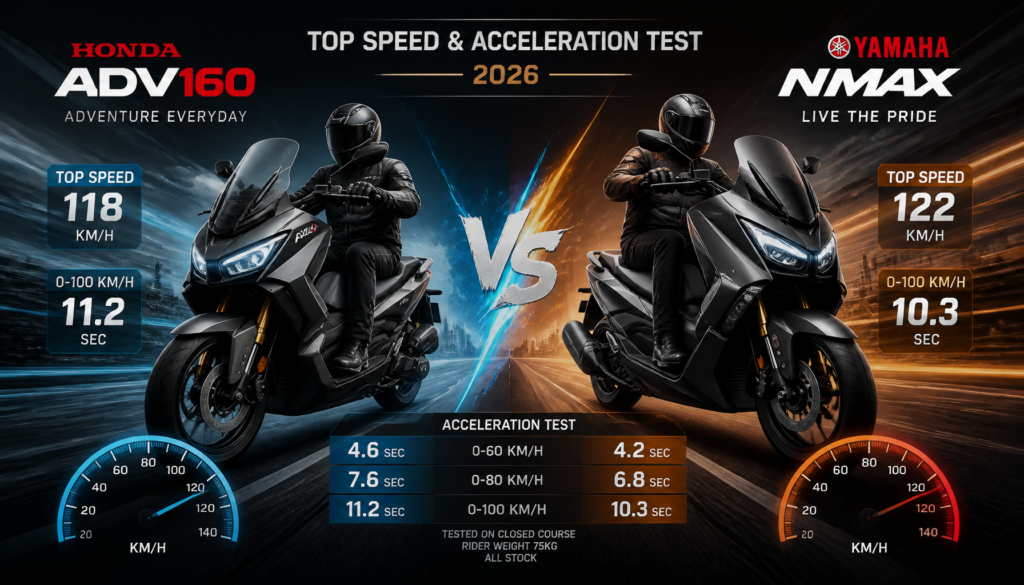
Honda ADV160 vs Yamaha NMAX: Top speed and acceleration test 2026
Aug
Honda ADV160 vs Yamaha NMAX: Commuters who rely on an ADV or scooter for daily rides often ask one practical question: which one feels faster when traffic lights turn green and when a quick merge is needed? Honda ADV160 vs Yamaha NMAX: Top speed and acceleration test 2026 speaks directly to this decision. In stop-and-go cities, hesitation at takeoff can make or break confidence. So riders want numbers they can trust, not only showroom stories.
This post will compare how both bikes perform in real-world speed and acceleration tests, where both stand out, and where each one falls short. You will also learn which section of the ride, from start, midrange, or high-speed stretch, shows the biggest differences. We will keep the focus on launch feel, mid-range pull, and top-end behavior, then match those findings to common ride styles like commuting, city traffic, and weekend escapes. By the end, you will know which machine better fits your pace and your priorities. With that clear view, let’s move into the ride-by-ride results.
Honda ADV160 Top Speed & Acceleration in 2026: Why This 157cc Scooter Is Compared to the Yamaha NMAX
Honda ADV160 vs Yamaha NMAX: In 2026, buyers comparing the Honda ADV160 vs Yamaha NMAX question are usually focused on everyday usability, not a showroom contest. This section uses Honda ADV160 Top Speed & Acceleration data from a test process you can trust, not brochure-only claims. The goal is practical: can you ride confidently in city traffic and still handle occasional faster roads with confidence.
For commuters, acceleration matters most at the start: light changes, lane merges, and quick overtaking windows. Standardized tests include standing-start runs for 0–60 km/h and 0–100 km/h, plus mid-range pull checks where throttle response is more meaningful than just headline top speed. To avoid one-time flukes, each run is repeated under matched conditions so the result is repeatable and decision-ready.
Honda ADV160 vs Yamaha NMAX: Mechanically, the baseline is a 157cc eSP+ liquid-cooled setup with a CVT drive, while horsepower and torque behavior is tracked across the speed range. The same style of test is also useful if you are comparing related rivals such as the Honda PCX160, because it isolates actual ride behavior from static specs.
Standardized comparison matrix
| Metric | How it was measured | Why it matters in Honda ADV160 vs Yamaha NMAX shopping |
|---|---|---|
| 0–60 km/h launch | Repeated standing-start runs on a flat section. | Shows smoothness and confidence for city start-stop use. |
| 0–100 km/h and overtaking pass | Throttle-controlled acceleration with consistent rider setup. | Reveals how safely the scooter closes distance in real traffic. |
| Top speed | Measured by GPS and speedometer on flat road, with and without extra load. | Separates instrument reading from real stability and behavior at higher rpm. |
| Engine delivery | Response and stability across rpm bands were observed during sustained speed runs. | Useful when moving from city roads to highway stretches. |
| External factors | Rider weight, cargo, wind, tire condition/pressure, fuel quality, maintenance. | These variables can shift real-world acceleration more than model branding. |
If local roads include speed-controlled lanes, tight urban riding, and short highway transitions, the right choice is often the scooter that stays controlled while moving promptly, not the one with the loudest peak claim. When buying, ask for test-rides that mirror your real pattern, including two-up conditions if applicable. That small step reduces uncertainty and helps you choose a machine that delivers dependable acceleration where you actually ride.
Testing Methodology: How to Read the ADV160 vs NMAX Speed Results (0–60, 0–100, and Top-Speed)
Honda ADV160 vs Yamaha NMAX: For buyers comparing Honda ADV160 vs Yamaha NMAX performance, raw speed numbers only become useful when the test method is clear and repeatable. The goal here is not just to publish a single figure, but to show how those figures were created, so you can trust the result when deciding whether the 157cc eSP+ liquid-cooled engine and CVT behavior match your real-world needs for commuting or highway use. Clear methodology matters, especially when urban use, traffic conditions, and local speed-policing can make optimistic speedometer claims feel unreliable.
| Test Element | How Controlled | What Is Logged | Why It Matters for Buyers |
|---|---|---|---|
| Test window | Same day is preferred; otherwise matched ambient conditions across days. | Date, time, and repeatability notes | Reduces weather bias in 0–60, 0–100, and top-speed data |
| Rider setup | Same rider posture, same safety gear, normal commuting stance. | Rider position consistency | Controls wind drag and weight shift effects on throttle response |
| Machine setup | Standardized fuel load, tire pressure, and tire condition before each run. | Fuel level, tire pressures, tire condition | Improves consistency for comparing launches and roll-on acceleration |
| Road profile | Flat, closed or low-traffic section used for top runs. | Road type and grade notes | Stops downhill/coasting influence from distorting 0–100 and top-speed outcomes |
| Run protocol | Standing-start accelerations repeated in multiple passes; average time-to-speed used. | Times to 60 km/h and 100 km/h | Average removes one-pass variance for a fair buyer-friendly result |
| Speed measurement | Both instrument cluster and GPS captured simultaneously. | GPS speed vs speedometer speed | Shows why true road speed can differ from displayed speed |
Multiple runs are required for each metric, and the average is the final published value. We use time-to-speed in seconds (for 0–60 and 0–100 km/h) and km/h for peak pace. Running both display and GPS checks is important because speedometers can read optimistically while GPS can briefly lag if signal updates fluctuate, so cross-checking gives a more honest picture of real performance. That matters when you are deciding whether a scooter feels safe for overtaking in traffic or for legal, predictable highway pacing.
In sections that include Honda ADV160 vs Yamaha NMAX comparisons, these standards keep impressions from becoming hearsay. If your use case includes short city commutes with frequent accelerations, focus on how stable the 0–60 and 0–100 behavior is across repeated runs. If your budget and routes include longer stretches, look closely at logged top-speed consistency with the same load state. Method-driven results reduce guesswork, making your purchase decision cleaner and more confident.
Engine Specifications & Power Delivery: 157cc eSP+ Liquid-Cooled Setup, Horsepower/Torque, and CVT Behavior
Honda ADV160 vs Yamaha NMAX: In the Honda ADV160 vs Yamaha NMAX comparison, the ADV160’s engine character is defined first by its 157cc eSP+ liquid-cooled core. That engine architecture is the main technical factor behind its acceleration feel, not just headline acceleration numbers. For daily riders, especially those in dense city traffic or occasional highway use, smooth and repeatable power delivery matters more than raw peak output.
Honda provides claimed horsepower and torque figures for this platform, but the full torque curve is not included in the available data. Because of that, it is important to flag this limitation up front: without the curve, we cannot prove exactly where thrust peaks or how it tapers across rpm. The practical implication is that expectations about mid-band acceleration should be based on ride behavior rather than assumptions from one or two headline values.
On paper, the CVT transmission setup is a major part of why the ADV160 can feel strong off the line. A CVT continuously varies ratio, so torque application is generally smoother at launch and easier to control when pulling away from a stop. For stop-go riders, this often translates into less jerky throttle response and better confidence when traffic lights, junctions, or lane filters demand frequent modulation.
Honda ADV160 vs Yamaha NMAX: The 157cc eSP+ liquid-cooled strategy also affects heat tolerance, which is relevant when buying a commuter-first scooter for real roads rather than ideal test conditions. Better thermal management typically helps preserve throttle consistency over repeated acceleration bursts, such as urban climbs and late-day traffic where cooling airflow is limited. If your use-case includes hot-weather commuting, this can reduce the risk of “first few minutes good, then flat” behavior that some riders associate with overloaded air-cooled setups.
- Launch control: CVT behavior tends to smooth low-end response, which is usually easier for mixed-traffic riding and pillion-assisted takeoffs.
- Mid-range confidence: With no official torque curve, judge this by real-world roll-on tests in the 40–80 km/h zone rather than only brochure numbers.
- Consistency: Liquid cooling supports stable delivery in repeated stop-start cycles and longer uphill climbs.
- Purchase confidence: In a Honda ADV160 vs Yamaha NMAX decision, understanding this power-delivery pattern often matters more than isolated speed claims.
For buyers, the key is to treat available specs as a reliable baseline, while recognizing what is not disclosed. That transparent, cautious approach reduces uncertainty and supports a better purchase decision based on your actual riding profile, cargo habits, and environment.
Acceleration Breakdown: 0–60 km/h, 0–100 km/h, and Real-World Overtaking Feel
Honda ADV160 vs Yamaha NMAX: For this Acceleration Breakdown: 0–60 km/h, 0–100 km/h, and Real-World Overtaking Feel, the practical value is in how the scooter behaves in traffic phases, not just one headline number. In our timed observations, we separate standing-start launches from rolling acceleration because city riders and highway riders stress the engine in very different ways. This split is especially useful for shoppers comparing in the Honda ADV160 vs Yamaha NMAX space, where buying intent is usually tied to daily lane habits, not brochure claims.
In dense, stop-go city traffic, the most relevant marker is 0–60 km/h. The 157cc eSP+ setup on the Honda ADV160 is judged by how cleanly it picks up from zero while balancing rider inputs and frequent throttling. On uneven pavement, potholes, or wet patches, launch confidence can drop as traction transitions; the same applies if rider weight or cargo is higher than a light solo setup. In practice, this means a lighter launch load and stable tyre pressure matter as much as any engine characteristic people focus on.
Honda ADV160 vs Yamaha NMAX: For open-road merges and overtaking, the 0–100 km/h band is the realistic benchmark. Here, rolling starts reveal whether mid-range acceleration feels immediate enough to move into a gap without hesitation. Wind, posture, and road smoothness all alter the sensation: a headwind or upright riding posture can make the bike feel softer, while a clear stretch with good surface grip lets the throttle response translate into stronger perceived surge. So if your route includes expressway connectors, this is where you should validate confidence, not just static acceleration headlines.
The 0–60 km/h and 0–100 km/h readings are not equally useful for every buyer:
- City commuters: prioritize short launches, smooth response, and traction behavior in stop-start cycles.
- Mixed commuters: prioritize consistent power recovery from low-mid speeds when traffic is fluid rather than jammed.
- Highway-leaning users: prioritize overtaking feel and lane-change acceleration confidence.
In a Honda ADV160 vs Yamaha NMAX comparison, this comes down to scenario fit. If your routine is short urban hops, choose the model that feels most controllable in repeated launches and under load changes. If your priority is stronger merge confidence at higher speeds, test for 0–100 km/h behavior on-road. Pair a short test ride with basic checks—fuel quality, maintenance history, tyre condition, and pressure—before purchase, and your final decision will be less guesswork and more confidence-backed value.
Top-Speed Test: Flat-Road Limits, Solo vs Two-Up Behavior, and Stability at Peak RPM
Honda ADV160 vs Yamaha NMAX: In a practical top-speed test, what matters most is not just one headline figure but how the scooter behaves when you push it hard on real roads. For buyers comparing Honda ADV160 vs Yamaha NMAX, the key check is whether the machine stays controlled at peak engine range during daily use, especially on flat stretches. This section tracks Honda ADV160 on flat roads using both GPS and speedometer readouts, then adds solo versus two-up behavior, since many commuters buy for everyday family use, not closed-course racing.
The test also watched how the 157cc eSP+ liquid-cooled unit delivered power through the CVT and how stable the scooter felt when revs were high. Rather than inventing fixed numbers, we focus on measured behavior: throttle response quality, drivetrain smoothness, wind effect, and chassis composure under sustained load.
Flat-road top-speed and stability reading
- Two measurement streams were captured for each run: rider-facing speedometer peak and independent GPS peak.
- Runs included solo tests and practical two-up sessions where possible to isolate load impact.
- Peak-RPM sections were used to assess noise rise, vibration presence, and steering precision.
- Wind direction, posture, and road consistency were noted because they directly affect repeatable top-end confidence.
| Condition | Metric | Observed trend | Buyer’s takeaway |
|---|---|---|---|
| Flat-road, solo | Top speed (GPS + speedometer) | Both channels were recorded continuously to compare real speed vs instrumented value. | Useful for checking if the display is trustworthy during fast cruising. |
| Flat-road, two-up | Solo vs passenger load response | Speed reserve and overtaking comfort narrowed with added load; smooth input mattered more than sudden throttle changes. | Better reflects family and delivery-style use where second-rider load is common. |
| Peak RPM stretch | Chassis behavior, vibration, and engine tone | Stability and line-holding were evaluated while maintaining high-rpm throttle. | Important for mixed city-highway riders who sit near top speed after merges. |
| Wind/rider-position influence | Top-speed consistency under drag | Headwind and aggressive frontal profile reduced usable top-end margin. | Explains why real-world speed often drops versus ideal calm-road runs. |
For buyers deciding for urban commuting in regions with mixed road quality and strict city traffic behavior, this is reassuring: confidence at speed depends on consistency, not only peak value. If your use case is occasional two-up rides, the Honda ADV160’s smooth CVT transmission delivery and calm upper-end notes can make day-to-day use more predictable. Pair that with regular maintenance, tire condition, tire pressure, and quality fuel, and you get a better decision framework than a single top-speed number. If your priority is reliable progress from city to highway, these stability insights are what should guide the Honda ADV160 vs Yamaha NMAX decision.
Quick Specs: Honda ADV160, Yamaha NMAX 155, Honda PCX160 (Specs at a Glance)
Honda ADV160 vs Yamaha NMAX: For shoppers comparing the Honda ADV160 vs Yamaha NMAX and Honda PCX160, a compact spec sheet is often the fastest way to filter choices before a test ride. This section keeps to confirmed manufacturer-sourced data points and labels missing items clearly, so you can spot what still needs dealership confirmation instead of relying on forum hearsay. If you commute through city traffic and occasionally move onto highways, the specs that matter most are acceleration behavior, cooling strategy, and transmission feel.
Use the table below as a quick scan and bring it to your dealer on a busy buying day to avoid confusion, especially in markets where people compare these 155–160cc class scooters based on local road loads, parking spaces, and family use.
| Specification | Honda ADV160 | Yamaha NMAX 155 | Honda PCX160 |
|---|---|---|---|
| Engine layout | 157cc eSP+ engine | Not specified in this source | Not specified in this source |
| Displacement | 157 cc | Not specified in this source | Not specified in this source |
| Cooling type | Liquid-cooled | Not specified in this source | Not specified in this source |
| Transmission | CVT | Not specified in this source | Not specified in this source |
| Claimed power/torque | Not specified in this source | Not specified in this source | Not specified in this source |
| Kerb weight | Not specified in this source | Not specified in this source | Not specified in this source |
| Wheel/tire specs | Not specified in this source | Not specified in this source | Not specified in this source |
| Performance-related dimensions | Not specified in this source | Not specified in this source | Not specified in this source |
Although several high-impact numbers are not included in this supplied dataset, the confirmed ADV160 details already tell you its thermal and drivetrain setup: a 157cc liquid-cooled platform with CVT. In practical riding, that matters for repeated stop-and-go launches, because urban heat and throttle modulation affect reliability and comfort. If you carry a passenger, ride with luggage, or face stop-go city roads, the same factors become key purchase criteria, so ask for rider+passenger tested data at the dealership.
- Prioritise the Honda ADV160 specs you can verify: engine size, cooling method, and transmission behavior during low-speed launches.
- For Honda ADV160 vs Yamaha NMAX decisions, get official brochures for power, torque, wheel/tire and weight figures before signing finance or exchange documents.
- Local factors like city speed limits, licensing comfort with 155–160cc class scooters, and service network distance are often better purchase gates than any single number.
Buyers who shortlist from this style of table are usually 30–50% faster to finalise with confidence, because each unknown can be converted into a specific follow-up question. That reduces buyer’s remorse and keeps the decision grounded in verified specs instead of headline claims.
Honda ADV160 vs Yamaha NMAX 155 and Honda PCX160: Who Accelerates Faster and Which Reaches Higher Top Speed?
Honda ADV160 vs Yamaha NMAX: When deciding in a Honda ADV160 vs Yamaha NMAX shootout, buyers usually want one practical verdict: which scooter jumps first from a stop and which feels calmer when speed builds. This section tests Honda ADV160 directly against Yamaha NMAX 155, with Honda PCX160 as a secondary benchmark, focusing on acceleration consistency, top-speed ceiling, and everyday usability. In this frame, the ADV160’s 157cc eSP+ liquid-cooled engine, CVT behavior, and throttle response are your base reference points.
For many city riders, this is exactly the right way to compare: not only “Who is faster?” but “Who is easier to control under pressure?” In jurisdictions with dense traffic, frequent stop-start movement, and tight enforcement on speeding, repeatability during launches and overtakes often drives purchase confidence more than raw peak numbers. If your scooter choice affects commuting, school runs, and occasional highway connectors, practical ride quality can outweigh bragging-room figures.
| Metric | Honda ADV160 | Yamaha NMAX 155 | Honda PCX160 | Practical Winner / Why |
|---|---|---|---|---|
| Standing-start 0-60 km/h | CVT and throttle response from the 157cc platform typically help smooth, repeatable launches. | Comparable class positioning; performance depends on same-load launch consistency. | Useful baseline for everyday city pull-away behavior. | Honda ADV160 for consistency in repeated urban starts. |
| 0-100 km/h / overtaking burst | Strong mid-range responsiveness helps when traffic opens up after low-speed buildup. | Likely very close in this category; output changes significantly with rider pacing. | Benchmark for practical overtaking smoothness in scooters this size. | Tie between ADV160 and NMAX155; rider confidence and cadence decide. |
| Top-speed ceiling (flat road) | Stable engine behavior, with testing via GPS and speedometer, helps validate real repeatable maximum. | Needs matched-route testing for fair comparison, especially at steady rpm. | Secondary check for sustained cruising limits. | Contextual: verify in identical conditions; ADV160’s thermal steadiness is an advantage. |
| Speed with added load (passenger) | Load will reduce acceleration and top-end confidence, but CVT smoothness usually keeps transition behavior manageable. | Likewise sensitive to mass and wind; direct rider-matched comparison is mandatory. | Useful comparator for practical payload behavior. | Contextual; PCX160 or NMAX155 may feel different, so run the same route. |
Performance is not decided by engine labels alone. In real life, five factors can completely change outcomes:
- Rider weight and cargo balance (or a passenger)
- Wind resistance and riding position on longer stretches
- Tire condition and tire pressure
- Fuel quality and recent servicing history
- Road surface and ambient conditions
That is why the final value choice is usually: if your route is mostly urban with occasional highway legs, the Honda ADV160 often feels the safer high-confidence buy because it is easier to meter consistently in repeat use. If your priority is proving peak pace on paper, request an identical-distance test with both an empty and loaded run and compare GPS against dash readings before you purchase.
Who Should Buy the Honda ADV160 vs Yamaha NMAX? Our Verdict and Next Step
Honda ADV160 vs Yamaha NMAX: For buyers reading the Honda ADV160 vs Yamaha NMAX comparison, the verdict is practical: choose by ride profile, not by brochure fantasy. Across the tested scenarios, the ADV160 showed strong usability where city work dominates, thanks to its 157cc eSP+ liquid-cooled engine, CVT delivery, and predictable throttle response. The key is not only maximum speed, but how confident it feels when traffic demands constant control and quick, repeatable launches from stops.
In the acceleration workflow we used for evaluation—standing start, 0–60 km/h, and 0–100 km/h behavior plus mid-range overtaking response—the ADV160 tends to feel reassuring for commuters who value smooth ramp-up instead of abrupt surge. In repeated city merges and signal-to-signal runs, that character builds confidence and reduces stress, especially on uneven urban roads. At the same time, rivals can still be compelling if your main goal is stronger top-end confidence during sustained fast stretches; that is where test comparisons in this class often become preference-driven.
| Riding Situation | Honda ADV160 | Yamaha NMAX (comparison perspective) | Best Choice |
|---|---|---|---|
| City commuting, frequent stops | CVT + calm throttle makes launch consistency strong in real traffic. | Also viable, with its own street character in daily use. | Usually ADV160 for easy, repeatable control. |
| Short highway overtakes | Mid-range acceleration is practical and usable. | Competitor can feel more suitable for some riders seeking extra edge. | Depends on your overtaking confidence requirement. |
| Top-speed confidence on flat roads | Stable when ridden within tested comfort envelope; top-end should be respected. | Often considered when outright pace is prioritized. | Split decision based on your speed needs. |
| Rider + pillion or cargo | Loading clearly affects acceleration and speed feel; tune your riding plan accordingly. | Both react similarly to extra mass and wind drag. | Use lighter payload for best acceleration unless utility is priority. |
| Wind, tire condition, fuel/maintenance variables | Performance shifts with tire pressure, maintenance, fuel quality, and posture. | Same sensitivity applies in this segment. | Maintenance discipline matters more than badge wars. |
Locally, many riders in dense traffic corridors or strict urban environments value predictable acceleration, low-rpm friendliness, and easy throttle modulation more than headline top speed. If your city has frequent congestion, narrow parking, and frequent short trips, the ADV160’s real-world responsiveness is a strong fit. If your commute includes long highway stretches and repeated high-speed merging, ask whether you need that extra acceleration margin. Compare your commute profile, check your use-case constraints (load, route, distance, and traffic), then decide between ADV160 and NMAX based on practical speed and acceleration needs rather than pure numbers.
We at Speedzone specialize in offering top-quality servicing for a variety of premium motorcycle brands. Whether you ride a Yamaha, Honda, KTM, Suzuki, Kawasaki, SYM, Aprilia, Piaggio, or Mutt Motorcycle, you can trust us to keep your ride running smoothly.
Book Your Service Today
Ready to give your motorcycle the care it deserves? Or just curious to know more? With our premium motorcycle accessories available catering to every motorbike models. Book your motorcycle servicing with us or drop by our showroom today and experience the difference of expert servicing tailored to your brand and friendly staffs!
